
|
|
A
|
-
ABT
-
American Backgammon Tour, an annual master-point competition of participants in major U.S. tournaments. Website: ABT.
-
Accept a Double
-
To agree to continue playing a game at twice the previous stakes after the opponent offers a double. Compare: Refuse a Double.
-
Ace
-
A rolled die showing the number 1.
-
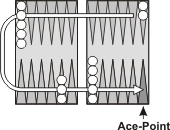
Ace-Point
-
Traditional name for the one-point.
-
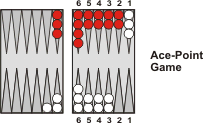
Ace-Point Game
-
A position in the late stages of a game in which a player is anchored on the opponent's one-point trying to hit a shot as the opponent brings his checkers home and bears them off.
-
Acey-Deucey
-
[Also spelled "Acey-Deucy" or "Acey-Ducey".]
- The roll of 1 and 2 with two dice.
- A backgammon variant in which the roll of 1 and 2 gives the player extra turns. See: How to Play Acey-Deucey.
-
Acting Captain
-
In a chouette, the crew member who plays for the team against the box after the original captain has declined box's double and is no longer in the game.
-
Action Play
-
A play designed to provoke an exchange of hits, typically used after the opponent has escaped his runners.
-
Action Position
-
A position in which one player doubles based upon his immediate blot-hitting chances.
-
Active Builder
-
A checker which is completely free to make another point.
-
Advanced Anchor
-
An anchor on the opponent's five-point, four-point, or sometimes three-point. (The opponent's bar-point is also sometimes called an advanced anchor, though purists insist that only points in the opponent's home board should be called "anchors.") See: Holding Point.
-
Advanced Level
-
A player of considerable experience and skill who has moved beyond intermediate level.
-
Ahead in the Count
-
Having a lower pip count than your opponent; see count (2).
-
Ahead in the Race
-
Having a lower pip count than your opponent.
-
Air Ball
-
An unexpectedly poor roll, especially one that fails to hit or fails to make a point.
-
Ammunition
-
Checkers in position to carry out an attack, in particular, checkers in the zone.
-
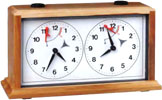
Analog Clock
-
A traditional chess clock with hands that show the time remaining for each player. It has a flag that falls to indicate when a player's time has expired. Analog clocks generally do not have a time delay feature, making them less suitable than digital clocks for use in backgammon.
-
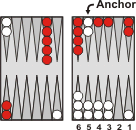
Anchor
-
A point (1) occupied by two or more of your checkers in the opponent's home board.
-
Annotated Match
-
A recorded match with added analysis and commentary. Example: The annotated match between Kit Woolsey and Jeremy Bagai.
-
Annotation
-
Analysis and commentary about a backgammon game written after the game is played.
-
Anti-Joker
-
A very bad roll; the opposite of a joker.
-
Army
-
The formation of a player's checkers as they work together to block and attack the opponent, then and come home safely.
-
Around the Corner
-
A move from the opponent's outer board to the player's outer board.
-
Asset
-
A feature that contributes to the strength of a position, such as made points and flexibility. Compare: Liability.
-
Attacking Game
-
Blitz (1).
-
Attack Zone
-
See: Zone of attack.
-
Automatic Doubles
-
An optional rule in money play: If both players throw the same number on the first roll of a game, the stakes are doubled. The doubling cube is turned to 2 and stays in the middle. Players usually agree to limit the number of automatic doubles to one per game.
-
Automatics
-
Automatic doubles.
-
Awkward Number
-
A dice roll which forces a player to leave a shot or break a valuable point (2).
|
|
|
B
|
-
Back Game
-
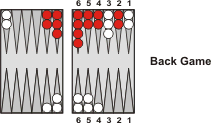
[Also spelled "backgame".] A strategy employed by a player who is substantially behind in the race but has two or more anchors in the opponent's home board. The back game player tries to hold both anchors as long as possible and force his opponent to bear in or bear off awkwardly. The idea is to hit a late shot and then contain the hit checker behind a prime. See posts by
Daniel Murphy and Marty Storer. Compare: Holding Game.
-
Backgammon
-
- A game played with dice and checkers on a board consisting of twenty-four points (1), in which each player tries to move his checkers home and bear them off while preventing the opponent from doing the same thing. See: the Rules of Backgammon.
- A completed game of backgammon (1) in which the losing player has not borne off any checkers and still has one or more checkers on the bar or in the winner's home board. A backgammon is also called a triple game because the winner receives three times the value of the doubling cube. Compare: Single Game and Gammon.
-
Backgammon Board
-
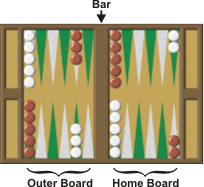
Backgammon (1) is played on a board consisting of twenty-four narrow triangles called points (1). The triangles alternate in color and are grouped into four quadrants of six triangles each. The quadrants are referred to as a player's home board and outer board and the opponent's home board and outer board. The home and outer boards are separated from each other by a ridge down the center of the board called the bar.
-
Backgammon Server
-
A computer on the Internet which hosts games of backgammon (1). Competitors play in real time with opponents from around the world. The server rolls the dice, communicates the plays to each player, keeps score, and maintains ratings for all players. Some servers even let you play for money. You typically interact with a server using client software downloaded to your computer. See: Backgammon Play Sites.
-
Back Man
-
Runner; a player's rearmost checker.
-
Baffle Box
-
A device through which dice are dropped to randomize a roll. The dice are deflected and jostled about as they fall through the box.
-
Bakelite
-
An early type of plastic, used in the 1920's and 1930's for the creation of backgammon playing pieces. Many people prefer the look and feel of bakelite to newer materials. See post by Albert Steg.
-
Banana Split
-
[Because you must be "bananas" to try it. Attributed to Kent Goulding."] To hit loose by breaking a point in your home board, thereby leaving two blots.
-
Bankroll
-
The amount of money you have available for betting, or the maximum amount you are willing to lose in a session. See: Money Management.
-
Bar
-
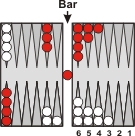
The raised ridge down the center of a backgammon board dividing the home board from the outer board. Checkers are placed on the bar after they have been hit.
-
Barabino
-
[Named after backgammon expert Rick Barabino.] A roll of 5-4 from the bar used to make an anchor on the opponent's five-point.
-
Bar-Point
-
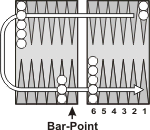
A player's seven-point, so named because it is physically adjacent to the bar.
-
Battle of Primes
-
A position in which both players have checkers trapped behind an opponent's prime. See: Prime-vs-Prime.
-
Bear In
-
To move a checker into your home board prior to bearing off.
-
Bear Off
-
To remove a checker from the board according to a roll of the dice after all of your checkers have been brought into your home board.
-
Bearoff
-
The last stage of the game during which checkers are borne off.
-
Bearoff Database
-
A computer-generated table associating each possible bearoff position with a value that represents the quality of that position. The associated value is either the equity of the position (in a two-sided database) or a distribution of the expected number of rolls to bear off (in a one-sided database).
-
Bear On
-
To be within six points (1) of, and therefore reachable with a single number of the dice. For example, a checker on the 13-point bears on points 12 through 7.
-
Beaver
-
An immediate redouble by a player who just accepted a double. A player who beavers turns the cube up one level and retains possession of the cube. See: Beavers.
-
Beavers
-
A rule often used in money play (but never in match play) which says: A player who accepts a double may immediately redouble (beaver) without giving up possession of the cube. The opponent (the player who originally doubled) may refuse the beaver, in which case he resigns the game and loses the current (doubled) stakes. Otherwise, he must accept the beaver and continue the game at quadruple the stakes prior to the double. See post by Sander van Rijnswou.
-
Behind in the Count
-
Having a higher pip count than your opponent; see count (2).
-
Behind in the Race
-
Having a higher pip count than your opponent.
-
Bertha
-
To mistakenly play the roll of 6-5 from the opponent's one-point to your mid-point without seeing that the opponent has made his bar-point and blocks your way.
-
BIBA
-
British Isles Backgammon Association. Website: BIBA.
-
Big Play
-
A bold or aggressive play when a safer but less constructive play is available.
-
Binache
-
Beaver.
-
Blitz
-
- An all-out attack on enemy blots in your home board aimed at closing out your opponent.
- A quick elimination tournament consisting of short matches.
-
Block
-
- [Noun.] A point (1) occupied by two or more checkers held for the purpose of hindering the opponent's progress.
- [Verb.] To prevent forward movement of the opponent's checkers by making points in front of them.
-
Blockade
-
A series of blocks arranged to prevent escape of the opponent's runners. The ideal blockade is a prime.
-
Blocking Backgammon
-
A backgammon variant in which one checker by itself controls a point (1). See: How to Play Blocking Backgammon.
-
Blocking Game
-
A game plan where the primary strategy is to build a strong blockade.
-
Blot
-
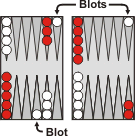
A single checker sitting alone on a point (1) where it is vulnerable to being hit.
-
Blot-Hitting Contest
-
An exchange of loose hits in which both players try to gain a key point.
-
Blue game
-
A kind of collusion in a chouette. Two or more players silently agree to share their winnigs, thus if either of them is in the box and the other is captain, the captain deliberately makes bad moves or wrong doubling decisions. (From Philipp Martyn on Backgammon, p. 162.)
-
Blunder
-
A large checker play or cube error, especially one made out of recklessness or inattention. Compare: Whopper. See post by Daniel Murphy.
-
Board
-
- A backgammon board.
- One of the four quadrants that make up the playing area: your home board, your outer board, the opponent's home board, and the opponent's outer board.
- A player's home board. For example: a strong board is a home board with several made points; an n-point board is a home board with n points made; to make your board means to close all the points in your home board.
-
Board Layout
-
See: Starting Position.
-
Board Setup
-
See: Starting Position.
-
Bold Play
-
A play that leaves one or more blots that the opponent can easily hit. Compare: Safe Play.
-
Bold-Safe Criteria
-
See: Magriel's Safe-Bold Criteria.
-
Book a Checker
-
Cover a blot.
-
Bot
-
[Contraction of "robot."]
- A computer program on a backgammon server that plays and competes just as if it were a human player.
- Any computer program that can play backgammon (1) and analyze positions (such as Jellyfish, Snowie, or GNU Backgammon).
-
Box
-
[Short for "man in the box," a person in a difficult or trying position.] The player in a chouette who plays alone against all the others.
-
Boxcars
-
A roll of 6-6 (double 6's).
-
Boxes
-
A roll of 6-6 (double 6's).
-
Boys (The Boys)
-
A roll of 6-6 (double 6's).
-
Break
-
To take apart, as in break a point, break a prime, or break one's board.
-
Break a Point
-
To remove a checker from a point (1) that contains only two checkers, thus leaving an open. (The opposite of make a point.)
-
Break a Prime
-
To open one or more points (2) in a prime.
-
Break Contact
-
To move past the last of the opponent's checkers, so that no further hitting or blocking is possible. The game becomes a pure race.
-
Break One's Board
-
To open one or more points (2) in your home board after having made your board.
-
Broken Prime
-
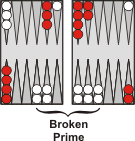
An incomplete prime with a gap in it.
-
Bronstein Clock
-
A chess clock with a feature that allows a time delay with each move. See also: Fischer Clock.
-
Builder
-
A checker brought into your outer board where it bears directly onto one or more key points that you want to make.
-
Build One's Board
-
To make points in your home board.
-
Bump
-
Hit a checker.
-
Bump and Pass
-
Pick and pass.
-
Bump and Run
-
Pick and pass.
-
Bury a Checker
-
To play a checker deep within your home board where it has no value.
-
Busted Back Game
-
A backgame attempt that fell apart when the backgame player was forced to move checkers deep into his home board where they could no longer contain a hit checker.
-
Button up
-
To safety a blot by bringing it together with another checker.
-
Bye
-
[As in "go by".] The position of a player in a tournament who advances to the next round without playing a match. Byes are often randomly awarded in the first round of an elimination tournament to make the number of players in the second round an exact power of 2.
-
BYOB
-
Acronym of "bring your own board," sometimes used in announcement of live tournaments.
|
|
|
C
|
-
Calcutta Auction
-
A lottery of entrants in a backgammon tournament. At the start of the tournament, players are auctioned off and the proceeds go into a pool to be distributed later to the buyers of the successful players. Sometimes players are grouped into fields, with each field sold as a package. The rules usually allow a player to buy back a portion of himself if he wants to increase his stake in the tournament. See posts by Toni Wuersch and Chuck Bower.
-
California Rule
-
An optional rule that says the winner of the opening roll has the option of rerolling both dice if he also turns the cube to 2. (The cube remains in the center.) See post by Peter Anderson.
-
Candlesticks
-
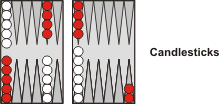
A position in which a player's checkers are piled high on a few points (1).
-
Captain
-
In a chouette, the leader of the team playing against the box. He rolls the dice and makes the final decisions for the team.
-
Cash a Game
-
To offer a double which you believe will be refused so you can collect the current value of the cube; claim a game.
-
Cast
-
To throw a pair of dice.
-
Catalin
-
An early plastic, similar to bakelite, that was popular in the 1930's and 40's in the creation of backgammon playing pieces.
-
Catchers
-
Checkers which have been purposely spread out to maximize the chance of hitting an opposing checker if it tries to escape.
-
Centered Cube
-
The position of the doubling cube before either player has offered a double. A centered doubling cube is placed halfway between the players at the start of each game with the number 64 facing up (representing a value of 1).
-
Championship Division
-
Open division.
-
Chase
-
Play dangerously, especially in offering or accepting doubles, in an attempt to recover losses.
-
Checker
-
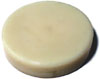
One of the fifteen markers, all of one color, that a player moves around the board according to rolls of the dice. Also known as men, pieces, stones, or counters.
-
Checker Play
-
- The movement of the checkers according to numbers on the dice.
- The art or skill of moving the checkers. Compare: Cube Play (2).
-
Chequer
-
British spelling of checker.
-
Chess Clock
-
Two adjacent connected clocks with buttons that stop one clock while starting the other so that the two component clocks never run simultaneously. The purpose is to keep track of the total time each player takes and ensure that neither player unduly delays the game. Clocks may be analog or digital. Digital clocks work best in backgammon because they have a time delay feature.
-
Chouette
-
[Pronounced "shoo-ETT". From the French word for "barn owl," a bird that is often attacked by all other birds.] A social form of backgammon for three or more players. One player, the box, plays on a single board against all the others who form a team led by a captain. See: How to Run a Chouette.
-
Cinque-Point
-
Traditional name for the five-point.
-
Claim a Game
-
To offer a double which you believe will be refused so that you can collect the current value of the cube; cash a game.
-
Clean Play
-
A move completed legally.
-
Clear a Point
-
To move all the checkers off of a point (1).
-
Clear from the Rear
-
A good general strategy to use when bearing in or bearing off against opposition. You clear your highest point (1) first and avoid creating gaps.
-
Client Software
-
Software that runs on a user's computer and communicates with a backgammon server to allow the user to play backgammon (1) with others on the Internet. The client software displays the board and interacts with the user as he rolls the dice and moves the checkers.
-
Clock
-
Chess clock.
-
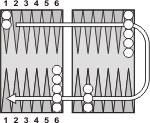
Clockwise
-
The direction your checkers move around the board when they are set up to bear off to the left. When your checkers move clockwise, your opponent's checkers move counterclockwise.
-
Close a Point
-
Make a point; place two or more of your checkers on a point (1), and thereby prevent your opponent from landing there.
-
Closed Board
-
A player's home board when all six points (1) are blocked.
-
Closed Point
-
A point (1) containing two or more checkers; a block or an anchor.
-
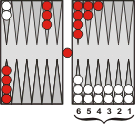
Close Out
-
To make all six of your home board points while the opponent has one or more checkers on the bar. The opponent is then prevented from entering his checker or making any other move until one of the closed home-board points is opened.
-
Cluster Count
-
A pip counting technique devised by Jack Kissane that involves the mental shifting of checkers to form patterns of reference positions whose pip totals often end in zero for quick and easy addition. See: "Cluster Count" by Jack Kissane.
-
Cocked Dice
-
Thrown dice which do not both land flat on the surface of the half of the board to the player's right. The roll is disqualified and both dice must be rethrown.
-
Cock Shot
-
Entering from the bar with a roll of 6-2 and hitting a blot on the eight-point when the only open point is the two-point.
-
Coffeehouse
-
Misleading talk to confuse opponent. For example, in a chouette, when a team player advises the captain not to double knowing full well that the captain will double, he tempts the box to unwisely accept (ethically borderline, at best). (From Backgammon, by Paul Magriel, p 396.)
-
Combination
-
- The two numbers on a pair of rolled dice taken together; see combinations of the dice.
- The play of a single checker that uses both numbers of a roll, such as a combination shot.
-
Combination Shot
-
An opportunity to hit an opposing blot that requires using the numbers on both dice taken together; an indirect shot. Compare: Direct Shot.
-
Combinations of the Dice
-
The number of possible rolls out of 36 that accomplish a specific objective.
-
Comeback Shot
-
An opportunity to hit an opponent's blot immediately after being hit yourself; in particular, an opportunity to hit from the bar.
-
Come In
-
Enter.
-
Comfort Station
-
Mid-point.
-
Committed Position
-
A position from which there is only one reasonable game plan for winning, as opposed to a noncommitted position.
-
Communicate
-
To keep checkers within six pips (2) of one another for mutual support; see connectivity.
-
Compact Position
-
A position with several made points close to one another and few gaps. Compact positions are powerful because spare checkers can easily build new points and rear points can be broken safely.
-
Confetti
-
What you sometimes get paid in if you are not careful with whom you play.
-
Confidence Interval
-
A range of values that contain, with a certain probability, a rollout's convergence value. For example, with a 95%-confidence interval, there is only a 5% chance that performing the same rollout an infinite number of times will yield a result outside the interval. See post by Stig Eide.
-
Connected Position
-
A position in which all fifteen of a player's checkers are located within a short distance of each other. A position which is well-connected will tend to stay well-connected.
-
Connectivity
-
The degree to which all of a player's checkers work together as a unified army without large gaps between them. Connected checkers defend each other and are easily made into points (2).
-
Consolation Division
-
Consolation flight.
-
Consolation Flight
-
A event for players eliminated early in the main flight of an elimination tournament; sometimes called a sympathy flight.
-
Consolidate
-
To reduce the number of blots a player has, frequently as a precursor to offering a double.
-
Consultation
-
Advice offered by the crew to the captain in a chouette.
-
Contact Position
-
A game where the opposing forces have not moved past each other and where it is still possible for one player to hit or block the other. Compare: Pure Race.
-
Contain a Checker
-
To prevent an opposing checker from escaping to its own side of the board by blocking it or hitting it and sending it back.
-
Control a Point
-
A player controls a point (1) if he has two or more checkers on that point. Only the player who controls a point may move additional checkers to that point.
-
Control the Cube
-
Own the cube.
-
Convergence Value (of a Rollout)
-
The value approached by a rollout as more and more trials are performed. It is the result you would obtain if you could do a rollout an infinite number of times.
-
Correspondence Games
-
Games played by e-mail.
-
Count
-
- Pip count.
- The relative standing of the players' pip counts. The player with the lower pip count is said to be ahead in the count.
-
Counter
-
Checker.
-
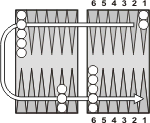
Counterclockwise
-
The direction your checkers move around the board when they are set up to bear off to the right. When your checkers move counterclockwise, your opponent's checkers move clockwise.
-
Counterplay
-
Possibilities for retaliation, switching from a defensive posture to an offensive posture.
-
Count the Position
-
To tabulate the players' pip counts to find out who is ahead in the race and by how much.
-
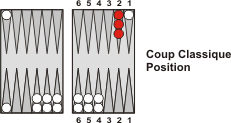
Coup Classique
-
A win from the seemingly unwinnable position in which your opponent has borne off twelve checkers and has just three checkers remaining on his two-point. You bravely maintain contact with a single checker on his one-point and deploy your other fourteen checkers where they can contain his checkers if you are able to hit one or, preferably, two of them. Winning a coup classique is especially satisfying for you and maddening for your opponent.
-
Cover a Blot
-
To add a second checker to a blot, thereby making the point.
-
CPW
-
Cubeless probability of winning.
-
Cramped
-
Having little or no mobility.
-
Crawford Game
-
The first game in a match after either player comes to within one point (4) of winning. The rules of match play say that the doubling cube may not be used during the Crawford game. See: Crawford Rule.
-
Crawford Rule
-
[Named for John R. Crawford.] A standard rule of match play. When the leading player comes within one point (4) of winning the match, the following game is played without a doubling cube. This one game without doubling is called the Crawford Game. After the Crawford game, the doubling cube is back in play again. See posts by: Chuck Bower, Kit Woolsey, and Walter Trice.
-
Crew
-
In a chouette, members of the team who play with the captain against the box.
-
Crossover
-
The movement of a checker from one quadrant of the board to an adjacent quadrant.
-
Crossover Count
-
The total number of crossovers needed to get all your checkers home and then borne off.
-
Crunch
-
The forced evacuation of desirable points (2) due to the lack of alternate plays; in particular, a position in which you are forced to bury checkers deep within your home board.
-
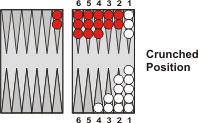
Crunched Position
-
A position which has collapsed, with several checkers being forced to the low points (1) in the player's home board while other checkers remain in the opponent's territory.
-
Crunching Position
-
A priming game in which one side is about to collapse, but has not done so yet.
-
Cube
-
- [Noun.] Doubling cube.
- [Verb.] To offer a double.
-
Cube Action
-
All of the cube decisions associated with a given position, namely: (a) whether the player on roll should double, and (b) whether his opponent should accept the double, refuse the double, or possibly beaver.
-
Cube Decision
-
The choice of whether or not to offer a double, or the choice of whether to accept, or refuse a double that has been offered.
-
Cubeful Equity
-
In money play with the doubling cube, the absolute value of a position to one of the players compared to the initial stake being played for. See: Equity. Cubeful equity considers the current value of the cube, cube ownership, and the potential for future doubles. In match play, cubeful equity corresponds to the probability of winning the match from the current position. Compare: Cubeless Equity.
-
Cubeful Rollout
-
A rollout performed with the doubling cube in play. All appropriate cube decisions are made as the position is played out. That means some trials will end in a dropped double and others will end with the cube at 2, or 4, or even higher. Cubeful rollouts more accurately simulate actual games than cubeless rollouts, but they have greater variance, so they do not converge as quickly. And cubeful rollouts may be more susceptible to systematic error because of cube misplays.
-
Cube Handling
-
The art or skill of making cube decisions.
-
Cube in the Middle
-
See: Centered Cube.
-
Cubeless Equity
-
The value of a position if the game is played without a doubling cube. This is a value between -3 and +3 and is equal to P(W) + P(Wg) + P(Wbg) - P(L) - P(Lg) - P(Lbg), where P(W) is the probability of winning the game, P(Wg) is the probability of winning a gammon (or backgammon), P(Wbg) is the probability of winning a backgammon, P(L) is the probability of losing the game, P(Lg) is the probability of losing a gammon (or backgammon), P(Lbg) is the probability of losing a backgammon. Compare: Cubeful Equity.
-
Cubeless Probability of Winning
-
The chance of winning the game if no doubling cube is used; also called game winning chances.
-
Cubeless Rollout
-
A rollout performed without using a doubling cube. Each trial is played to the end of the game and scored plus or minus 1, 2, or 3 points (4) depending on whether gamed ended in a single game, gammon, or backgammon (2). Because cubeless rollouts do not include cube play, they do not perfectly simulate a game, but cubeless rollouts have less variance and less systematic error than cubeful rollouts.
-
Cube Ownership
-
Which player has the right to make the next double. At the start of the game, the cube is in the middle and either player may double. After one player accepts another's double, he owns the cube, and only that player may make the next double.
-
Cube Play
-
- The act of offering a double, or the act of accepting or refusing the opponent's double.
- The art or skill of making cube decisions. Compare: Checker Play (2).
-
Cube Provocation Play:
-
- An error in checker play that induces the opponent to double on his turn. The ploy could be intentional, an attempt to get the opponent to double too early, but the term "cube provocation play" is often used mockingly to refer to an obvious error. See: Danny Kleinman (1980) "Cube Provocation Play".
- A correct checker play that leads the opponent to correctly double when at least one other play is available after which the opponent would be wrong to double. This can happen if the better play produces a more volatile position -- the opponent is forced to double because he has too many market losers. Examples are Wisecarver Paradox positions. See posts by Chuck Bower and others (2007).
-
Cube Proxy
-
A player in a chouette who temporarily handles the cube for another while that player is away from the game. See post by Ilia Guzei.
-
Cube Reference Position
-
A position for which the correct cube action is known which serves as a standard by which other similar positions may be judged. See post by Chuck Bower.
-
Cup
-
Dice cup.
-
Current Stake
-
The initial stake multiplied by the value of the doubling cube.
|
|
|
D
|
-
Dance
-
[From the action a player makes as he first reaches to enter his checker then pulls his arm back when he notices the numbers are blocked.] To throw numbers which fail to enter a checker from the bar.
-
Dansk Backgammon Forbund (DBgF)
-
Danish Backgammon Federation. Website: www.dbgf.dk.
-
Dead Checker
-
A spare checker deep in the player's home board where it serves no useful purpose. See: Bury a Checker.
-
Dead Cube
-
A doubling cube with no further doubling value. In match play, the cube is said to be dead when the player owning the cube has no reason to double. For example, a player who owns a 2-cube when he is two points (4) away from winning the match will never double because he can win the match with the cube at its current level.
-
Dead Man
-
Dead checker.
-
Dead Number
-
A specific number on the dice which cannot be played in the current position; see kill a number.
-
Decline a Double
-
Refuse a double.
-
Deep
-
On a low-numbered point (1), usually the one-point or two-point.
-
Deep Anchor
-
An anchor on the opponent's one-point or two-point.
-
Deuce
-
A rolled die showing the number 2.
-
Deuce-Point
-
Traditional name for the two-point.
-
Dice
-
[Plural of die.] Two small cubes, each with faces marked with spots (pips (1)) representing the numbers 1 to 6. Dice for backgammon usually have rounded corners so they roll more easily. You throw a pair of dice at the start of each turn, and move your checkers according to the numbers thrown.
-
Dice Combination
-
One of the 36 possible rolls using two dice.
-
Dice Cup
-
A container, usually made of leather, plastic, or wood, used for shaking and rolling dice. There is often a ridge around the inside of the open end designed to trip up the dice as they leave the cup. Dice cups make it possible to shake the dice thoroughly before rolling them, ensuring a random roll. Presumably dice manipulation is harder when dice are rolled from a cup.

-
Dice Manipulation
-
Any unfair means used to influence the roll of the dice. See post by Kit Woolsey.
-
Dice Mechanic
-
A person skillful in the use of unfair means to control the dice.
-
Dice Tube
-
See Meyer dice tube.
-
Die
-
Singular of dice.
-
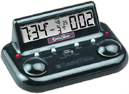
Digital Clock
-
An electronic chess clock with digital displays showing the time remaining for each player. A display shows 00:00 when a player has run out of time. Digital clocks typically have a time delay feature which makes them particularly well suited for backgammon. Compare: Analog Clock.
-
Dilly Builder
-
A spare checker which bears only on points deep in a player's home board.
-
Direct Hit
-
A hit using the number on just one die. You must be within six points of a blot to be able to hit it directly. Compare: Indirect Hit.
-
Direct Range
-
Reachable using a single number from one die. For example, a blot is in direct range of being hit if it is six points or less away from an opposing checker.
-
Direct Shot
-
A chance to hit a blot six points or less away using a single number from one die.
-
Disengage
-
To break all contact and turn the game into a pure race.
-
Disjointed Position
-
A position that is poorly connected, in which a player's army is divided into two or more groups with large gaps between them.
-
Distribution
-
The arrangement of checkers among points. A good distribution is compact with spares on most points. You don't want too many points or too few points (candlesticks).
-
Diversification
-
The spreading out of your checkers to increase the number of good rolls on your next turn. See post by Simon Woodhead. Compare: Duplication.
-
Division
-
One of the sections in a tournament into which players are divided according to their ability and experience. For example, a tournament might have a novice division, an intermediate division, and an open division.
-
DMP
-
Double match point.
-
Double
-
An offer made by one player to his opponent during the course of the game (on that player's turn, but before he has rolled the dice) to continue the game at twice the current stakes. The opponent may refuse the double, in which case he resigns the game and loses the current (undoubled) stakes. Otherwise, he must accept the double and the game continues at double the previous stakes. A player who accepts a double becomes owner of the cube and only he may make the next double in the same game.
-
Double Bump
-
Double hit.
-
Double Direct Shot
-
Double shot.
-
Double Ducks
-
The roll of 2-2 on the dice (double 2's).
-
Double Elimination
-
A tournament format in which a competitor continues playing until he has lost twice. Compare: Single Elimination.
-
Double Game
-
Gammon.
-
Double Hit
-
To hit two opposing blots on one turn.
-
Double In
-
To offer a double which should be properly accepted. Opposite of double out.
-
Double Jeopardy
-
Potential for awkward rolls both next turn and the turn after.
-
Double Match Point
-
- A match in which both players need just one more point (4) to win.
- A game in which the doubling cube has reached a high enough level that a win by either player also wins the match.
-
Double Out
-
To offer a double which should be properly dropped, thus taking your opponent out of the game. Same as cashing a game. Opposite of double in.
-
Doubler
-
Doubling cube.
-
Doubles
-
Two thrown dice with identical numbers on their upper faces.
-
Double Shot
-
One blot which can be directly hit two different ways, or two blots each of which can be directly hit one way. Compare: Single Shot.
-
Doublets
-
Doubles.
-
Doubling Block
-
Doubling cube.
-
Doubling Cube
-
A cubical block, slightly larger than a regular die, with the numbers 2, 4, 8, 16, 32, and 64 marked on its faces. It is used for keeping track of the increase in stakes of the game and the player who next has the right to double. The cube starts in the middle with the number 64 facing up (representing a value of 1). When you offer a double, you turn the cube to its next higher value and pass it to your opponent. If he accepts your double, he places the cube on his side of the board and becomes the owner of the cube. After the first double of a game, only the player who last accepted a double may make the next double. Rules that affect use of the doubling cube: automatic doubles, the Jacoby rule, and beavers.

-
Doubling on the Come
-
Offering a double in anticipation of a good roll.
-
Doubling Window
-
- The range of game winning chances which are both a proper double and a proper take.
- The range of game winning chances which would be a proper double and a proper take if neither player could use the cube again.
-
Down
-
An early-game move of a checker from the mid-point to the same player's outer board.
-
Draw
-
The random pairing of competitors in a tournament to determine who will play whom or who will get byes.
-
Drop
-
Refuse a double.
-
Dropper
-
[From the server message: Player xxx drops connection.] A player on a backgammon server who avoids a reduction to his rating by intentionally leaving a match he is about to lose before the result recorded.
-
Drop Point
-
The maximum game winning chances at which it is correct for a player to refuse a double; the point at which a player is equally well off accepting a double or refusing a double; take point.
-
Drop-Take
-
In a chouette, an agreement between two players after a double by the box that one player will accept the double, the other will refuse, and they will share their combined earnings or loss.
-
Ducks
-
Double ducks.
-
Duplicate Backgammon
-
A form of tournament play in which in which multiple pairs of competitors play with the same dice rolls in separate games and compare their results. See: How to Play Duplicate Backgammon.
-
Duplicate Dice
-
In a rollout, the use of the same sequence of random rolls with different candidate positions. The idea is that lucky rolls for one position will tend to be lucky for the other position as well, and luck will be less of a factor in the outcome. See post by David Montgomery.
-
Duplicate Tournament
-
See: Duplicate Backgammon.
-
Duplication
-
A position in which the same number can be used constructively in more than one way. For example, when your opponent can use a 5 to hit either of two blots, his 5's are said to be duplicated. All else being equal, a position which duplicates the opponent's good numbers is better than one which does not because it means the opponent has fewer good rolls in total. See post by Simon Woodhead.
-
Dutch Backgammon
-
A backgammon variant in which the players start with all their checkers off the board. See: How to Play Dutch Backgammon.
-
Dyscommunication
-
[Coined by Danny Kleinman in Double Sixes from the Bar.] The negative impact on flexibility of having spare checkers exactly six pips apart.
|
|
|
E
|
-
Early Game
-
The first few moves of a game, before the players have settled on a particular game plan.
-
Early-Late Ratio
-
A comparison of the cost of doubling slightly before opponent's drop point versus doubling slightly past opponent's drop point. This number varies depending on the score of the match, the level of the cube, and the chance of gammon in the current game.
It is useful in determining how aggressively a player should double to avoid losing his market. See post by Tom Keith.
-
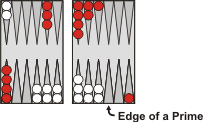
Edge of a Prime
-
The open point directly in front of a prime.
-
Effective Pip Count
-
The average number of rolls required to bear off all your checkers multiplied by the average pip value of a roll (49/6 pips). A player's EPC is equal to his actual pip count plus the wastage of the position. For more information, see article by Walter Trice and post by Douglas Zare. The EPC is also known as the Trice Count in honor of Walter Trice (1949–2009).
-
Efficient Double
-
A double made at or near the point of maximum effectiveness, when the opponent would be correct to either accept or refuse.
-
Eject
-
To abandon an ace-point game to avoid losing a backgammon (2) or a gammon.
-
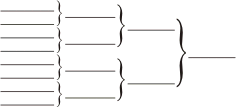
Elimination Format
-
A tournament event in which half the competitors are eliminated each round until just one player remains. Compare: Round Robin Format.
-
Elo Ratings System
-
A method of rating players devised by Arpad Elo for the U.S. Chess Federation in 1960. Most backgammon ratings systems are based on Elo's method; for example, see FIBS rating formula.
-
EMG Equity
-
Equivalent-to-money-game equity.
-
End Game
-
The phase of a game which starts when either player begins to bear off.
-
Enter
-
To move a checker from the bar to an open point in the opponent's home board according to a roll of the dice. When a player has a checker on the bar, this is his only legal move.
-
EPC
-
Effective pip count.
-
Equity
-
The value of a position to one of the players. Equity is the sum of the values of the possible outcomes from a given position with each value multiplied by its probability of occurrence. It is the same as the fair settlement value of the position. Your equity is the negative of your opponent's equity. See post by Gary Wong. Equity comes in different flavors. See: Cubeless Equity, Cubeful Equity, Match Equity, and EMG Equity.
-
Equivalent-to-Money-Game Equity
-
Cubeful equity normalized by transforming it linearly so that winning a single game at the current value of the cube is reported as +1 and losing a single game at the current value of the cube is reported as −1. EMG equity is commonly used in match play to compare the size of errors in different games. See the Snowie Support FAQ for a further description and an example.
-
ER Backgammon
-
ER stands for Error Rate. Playing ER backgammon means playing with a view to making the least errors from the outset rather than deliberately making suboptimal plays to steer the game toward a position that your opponent will misplay or doesn't understand.
-
Error Rate
-
A measure of the average equity lost per move due to errors in play. The lost equity can be measured either in match-winning chances or EMG equity. Different programs compute error rate differently: Snowie divides by the total number of moves and reports the rate in "millipoints per move." Gnu Backgammon divides by the number of unforced plays. See post by Gregg Cattanach.
-
Escape
-
To advance a runner to safety or past the opponent's blockade.
-
Establish a Point
-
Make a point.
-
Eureka
-
[Also spelled "Eureika".] Simplified backgammon, in which each player starts with two checkers on his one, two, and three-point, and three checkers on his four, five, and six-point. See How to Play Eureika.
-
Exposed Checker
-
A blot within range of a direct hit.
-
Extras
-
See: Mandatory Extras.
-
eXtreme Gammon
-
A neural-net backgammon program introduced in 2009. Website: eXtreme Gammon.
|
|
|
G
|
-
Gain a Tempo
-
Hit the opponent and thereby deprive him of half a roll.
-
Game Plan
-
A strategy for winning the game. The three major game plans are run, block, and attack.
-
Gamesmanship
-
The use of ethically dubious means to obtain an advantage in a game. This includes intentionally distracting, confusing, or generally duping an opponent. See post by Albert Steg.
-
Game Winning Chances
-
The probability of winning the current game if it is played to conclusion without a doubling cube; also called cubeless probability of winning.
-
Gammon
-
A completed game of backgammon in which the losing player has not borne off any checkers. A gammon is also called a double game because the winner receives twice the value of the doubling cube. Compare: Single Game and Backgammon (2). In money play, with the Jacoby rule in effect, gammons do not count if the doubling cube has not been turned that game.
-
Gammon Count
-
The minimum number of pips a player needs to roll to bring all his checkers home and bear off his first checker, thereby avoiding losing a gammon. Compare: Pip Count.
-
Gammon Cube
-
Jacoby rule.
-
Gammon-Go
-
A situation in match play where losing a gammon has no cost, but winning a gammon is particularly valuable. Examples: (a) you trail 4-away/2-away and opponent owns the cube at 2; or (b) you trail 2-away/1-away in the Crawford game; or (c) you trail 3-away/1-away after the Crawford game and the cube is at 2. Gammon-go for you is gammon-save for your opponent. See posts by Mary Hickey and Marty Storer.
-
Gammonish
-
A position that has a higher than normal gammon rate.
-
Gammon Price
-
The relative value of winning a gammon compared with the value of winning a single game. Gammon price is computed as GP = (WG - W) / (W - L), where WG = value of winning a gammon, W = value of winning a single game, and L = value of losing a single game. In money play, the gammon price is 50%. In match play, the gammon price depends on the score of the match and the level of the doubling cube. See posts by David Montgomery and Ron Karr.
-
Gammon Rate
-
The chance of a game ending in a gammon or a backgammon (2) if played to completion (i.e., without a doubling cube). Gammon rate may refer to a particular game in progress or to backgammon games in general. An individual player's gammon rate is the fraction of his wins which are gammons or backgammons. See post by David Montgomery.
-
Gammon-Save
-
A situation in match play where winning a gammon has no value, but losing a gammon is particularly costly. Examples: (a) you lead 2-away/4-away and own the cube at 2; or (b) you lead 1-away/2-away in the Crawford game; or (c) you lead 1-away/3-away after the Crawford game and the cube is at 2. Gammon-save for you is gammon-go for your opponent. See posts by Mary Hickey and Marty Storer.
-
Gammon Vigorish (Vig)
-
The additional equity resulting from the possibility of winning a gammon.
-
Gap
-
The space or spaces between made points.
-
GG
-
Gammon-go.
-
Gin Position
-
A position from which a player cannot lose.
-
Gioul
-
A Middle Eastern game in which a single checker controls a point (1) and doubles are very powerful. See: How to Play Gioul.
-
Girls (The Girls)
-
A roll of 5-5 (double 5's).
-
Give a Little Present to
-
Double.
-
Giving for Game
-
A statement made by a player in a chouette that he is willing to pay the captain or any other team member the full stake at which the game currently stands for the right to take over their games. The player making this offer does so because he wishes to double the box when the other players to do not.
-
GNU Backgammon
-
A neural-net computer program that plays backgammon (1) and analyzes positions and matches. GNU Backgammon is a cooperative effort of many volunteers. It is "free" software as defined by the GNU General Public License. See the post by Gary Wong and the tutorial by Albert Silver. Website: GNU Backgammon.
-
Golden Point
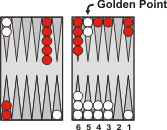
-
[Coined by Paul Magriel in his book Backgammon.] The opponent's five-point, the best place to build an anchor.
-
Go Out
-
To achieve the points (4) necessary to win a match.
-
Greedy Bearoff
-
A mode in some computer programs and on some backgammon servers where the computer will automatically bear off the maximum number of checkers possible.
-
Greek Backgammon
-
Tavli.
-
GS
-
Gammon-save.
-
Guff (Guffy)
-
A player's one-point.
-
Gul Bara
-
A Middle Eastern game in which a single checker controls a point (1) and doubles are very powerful. See: How to Play Gul Bara.
-
GWC
-
Game winning chances.
|
|
|
H
|
-
Half a Roll
-
One of the two numbers on a pair of thrown dice.
-
Half-Crossover Method
-
A pip counting method devised by Douglas Zare. See this post and this article.
-
Handicap
-
An artificial advantage given to a weaker player in an effort to equalize the chances of winning. Some popular handicaps are: (a) the weaker player gets to go first; (b) once during the game the weaker player gets to reroll if he doesn't like his roll; (c) the weaker player gets to start the game owning the cube; (d) the weaker player gets to start the game with a strong roll such as 5-3, 4-2, 6-5, or 3-1.
-
Hara-Kiri Play
-
A play which exposes blots for the purpose of recirculating the player's checkers; also known as a suicide play.
-
Head-to-Head
-
One player against another player for money.
-
Heavy Point
-
A point (1) with more than three checkers on it.
-
Hedge
-
A side bet between two players prior to competing in the final rounds of a tournament designed to protect the loser from going away empty handed. For example, two players competing for a $10,000 prize might agree beforehand that the winner will pay the loser $2,500. See this thread.
-
Hit
-
To move to a point (1) occupied by an opposing blot and put the blot on the bar.
-
Hit and Cover
-
To hit an opposing blot and then continue on with the same checker to cover your own blot.
-
Hit and Pass
-
Pick and pass.
-
Hit and Run
-
Pick and pass.
-
Hit and Split
-
To hit a blot with one number while splitting your runners with the other number. The hit provides protection for the advanced split checker, making it less likely the opponent will be able to point on it.
-
Hit Loose
-
To hit an opposing blot and while leaving your own blot(s) in danger of a return hit, particularly in your own home board.
-
Hit Off the Edge of a Prime
-
To hit an opposing blot sitting on the front edge of a partial prime to keep the blot from escaping.
-
Holding Game
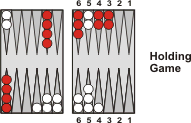
-
A strategy used when you are behind in the race and your opponent has escaped his runners. You make an advanced anchor on the opponent's side of the board and hold on to it as long as you can with the idea of hindering the opponent from bearing in safely. See this thread. Compare: Back Game.
-
Holding Point
-
The defensive point (2) you control when playing a holding game, usually the opponent's four-point, five-point, or bar-point.
-
Holland Rule
-
[Named after Tim Holland, who proposed the rule.] An optional rule in match play that was popular in the 1980's but is now rarely used. After the Crawford game a player may not double until at least two rolls have been played by each side. See post by Kit Woolsey.
-
Home
-
Home board.
-
Home Board
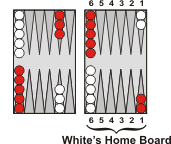
-
The quadrant containing your one-point through six-point. It is the last quadrant your checkers move to before they are borne off. It is also the quadrant your opponent must use to enter any of his checkers sitting on the bar. Your home board is also called your inner board or inner table.
-
Horizon
-
The number of plies played in each trial of a truncated rollout. A rollout that is truncated after 10 plies has a 10-ply horizon.
-
Hustler
-
A player who, by charm or other means, persuades another player to take part in game where the other player is at a disadvantage.
-
Hyper-Backgammon
-
A backgammon variant where each player has just three checkers. See: How to Play Hyper-Backgammon.
|
|
|
I
|
-
Illegal Move
-
A move that does not conform to the roll of the dice as defined by the rules of backgammon. An illegal move must be corrected if requested by the opponent before the opponent rolls the dice to begin his own turn. See: Illegal Moves Rule.
-
Illegal Moves Rule
-
The standard rule in backgammon which says: If a player makes an illegal play, the opponent has the option of allowing the error to stand or requesting that it be corrected. He must make this request before rolling the dice to begin his own turn. Once a correction is requested, the illegal mover is free to make any legal play he chooses. Compare: Legal Moves Rule.
-
Illegal Play
-
A play that does not conform to the roll of the dice as defined by the rules of backgammon. An illegal play must be corrected if requested by the opponent before the opponent rolls the dice to begin his own turn. See: Illegal Moves Rule.
-
Illegal Position
-
A position which cannot be reached through any sequence of legally played rolls. For example, both players closed out with checkers on the bar is an illegal position. Illegal positions are not allowed under the rules, and any misplay that creates an illegal position must be corrected.
-
Inactive Builder
-
A checker that is presently part of a prime or a block but which has the prospect of being used later to make another point.
-
Indirect Hit
-
A hit that uses the numbers on both dice taken together. Compare: Direct Hit.
-
Indirect Shot
-
An opportunity to hit an opposing blot using the numbers on both dice taken together; a combination shot. Compare: Direct Shot.
-
Initial Double
-
A double offered while the cube is still in the center, as opposed to a redouble where the player making the double has possession of the cube.
-
Initial Stake
-
The amount initially wagered in a game of backgammon (1). At the end of the game, this amount is multiplied by the final value of the doubling cube, and further multiplied by 2 if the win is a gammon or 3 if the win is a backgammon (2).
-
Initiative
-
A term used to describe a situation where one player has relative freedom to build his position or attack the opponent as he chooses, while the other player is reduced to making forced plays and trying to stave off disaster. The first player is said to have the initiative.
-
Inner Board
-
Home board.
-
Inner Table
-
Home board.
-
Intermediate Division
-
A division of a tournament designed for players too strong for the novice division and who do not wish to compete in the open division.
-
Intermediate Level
-
A player of some experience who has begun to hone his skills; the level of play between novice and advanced.
-
In the Air
-
On the bar.
-
Irish
-
A sixteenth-century game popular in England and other European countries, and probably backgammon (1)'s direct ancestor. Rolls of doubles are played just like any other roll, and there are no gammons or backgammons (2). See: How to Play Irish.
|
|
|
J
|
-
Jackpot
-
A elimination event, usually with a large entry fee, in which only the winner and runner-up receive prize money.
-
Jacoby Paradox
-
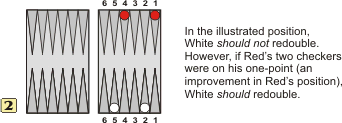
[Named for Oswald Jacoby, who mentioned it in The Backgammon Book, page 116.] The fact that an improvement in the opponent's position can make redoubling correct in a position in which the player on roll owns the cube and has one remaining chance to redouble.
-
Jacoby Rule
-
[Named for Oswald Jacoby, who proposed the rule.] A rule popular in money play which says that gammons and backgammons (2) count only as a single game if neither player has offered a double during the game. The Jacoby rule is not used in match play. The rule speeds up play by eliminating situations where a player avoids doubling so he can play on for a gammon. See post by Daniel Murphy.
-
Jacquet
-
A game once popular in France in which players start at diagonally opposite corners and move around the board in the same direction. See: How to Play Jacquet.
-
Janowski's Formula
-
A formula devised by Rick Janowski for estimating match equity (1) at a given score. If d is the difference in match score and t is the number of points (4) the trailing player has to go, then the probability of the leading player winning the match is .5 + .85d / (t+6). See also: Neil's Numbers and Turner's Formula.
-
Janowski's Formulas
-
A collection of formulas devised by Rick Janowski for estimating cubeful equity from cubeless equity. The basic formula for cubeful equity (between take points) is:
CF = CL*(1 - x) + CE*x where CF is cubeful equity, CL is cubeless equity, CE is cubeful equity assuming all doubles are perfectly efficient, and x is a number between 0 and 1 that measures the cube efficiency. Typical values for x range from 0.55 to 0.8. See also: Janowski's Takepoint Formula.
-
Janowski's Takepoint Formula
-
A formula devised by Rick Janowski for estimating your take point given your cubeless probability of winning the game. The basic takepoint formula is:
           2L - 1
    TP = -----------
         2W + 2L + x
where TP is the cubeless equity of your take point, L is the average value of your cubeless losses (e.g., −1, if you can't lose a gammon), W is the average value of your cubeless wins (e.g., +1 if you can't win a gammon), and x is a number between 0 and 1 (typically 0.55 to 0.8) that measures cube efficiency. See Janowski's article, Take-Points in Money Games.
-
Jellyfish
-
The first commercial neural-net backgammon program (1994) after TD-Gammon. Website: Jellyfish Backgammon.
-
Jeopardy
-
Potential for awkward rolls on a future turn. See also: Double Jeopardy.
-
Joint Standard Deviation
-
The standard deviation of the difference between two rollouts: JSD = sqrt(SD1*SD1 + SD2*SD2). A measure of how statistically significant the result is.
-
Joker
-
An exceptionally good roll, especially a roll that reverses the likely outcome of the game; a roll much luckier than average.
-
JSD
-
Joint standard deviation.
-
Junior
-
Affectionate name for a player's farthest-back checker.
|
|
|
K
|
-
Kamikaze Play
-
Breaking points in your home board in hopes of getting the checkers recirculated, a back game strategy.
-
Kauder Paradox
-
A position which is both a proper double and a correct beaver. This can happen only in money play with the Jacoby rule. By doubling, the underdog gets full value for his potential gammons, thus raising his equity; however, as long as this equity remains negative, the opponent should beaver.
-
Keith Count
-
A formula devised by Tom Keith for making cube decisions in pure race games. It is a modification of the basic pip count designed to take into account elements of checker distribution. Each player's Keith count is his pip count, plus 2 for each checker more than 1 on his one-point, plus 1 for each each checker more than 1 on his two-point, plus 1 for each checker more than 3 on his three-point, plus 1 for each empty space on points four, five, or six. Then the player on roll increases his count by one-seventh (rounding down). Keith advises: Double if your count exceeds your opponent's count by no more than 4; redouble if your count exceeds your opponent's count by no more than 3; take if doubler's count exceeds your count by at least 2. For a comparison with other methods, see the article, "Cube Handling In Noncontact Positions".
-
Key Point
-
A point (1) required to complete a prime in front of the opponent's runners; the four-point, five-point, and bar-point are usually key points.
-
Kibitz
-
- To watch a game or match.
- To make a comment during the game within hearing distance of the players (undesirable behavior in a tournament).
-
Kibitzer
-
Spectator to a game. Good etiquette dictates that kibitzers not discuss the game within earshot of the players.
-
Kill a Checker
-
To move an extra checker deep within your home board where it serves no useful purpose. See: Dead Checker.
-
Kill a Number
-
To create a position in which a specific number on the dice cannot be played on the following turn. Killing 6's, for example, is a way to preserve your timing in a priming battle or when defending against a back game. Compare: Save a Number.
-
Kleinman Doubling Formula
-
[Proposed by Danny Kleinman.] A guideline for cube handling in pure race positions. Compute K = (D+4)*(D+4) / (S-4), where D is the player's pip count minus the opponent's count, and S is the sum of the pip counts. Kleinman says a player should make an initial double if K > 0.44, or redouble if K > 0.61, and the opponent should accept a double or redouble if K < 1.2. See post by: Øystein Johansen.
-
Knock Off
-
Hit a checker.
-
Knockout Tournament
-
A type of tournament where you continue to play until you lose; an elimination tournament.
|
|
|
L
|
-
Ladder
-
- An ongoing competition in which players are ranked in approximate order of ability. Any player may challenge another player higher on the ladder, up to a given number of steps away. If the challenger wins, he moves up the ladder and his opponent moves down.
- Flight.
-
Last Call for Breakfast
-
A player's last opportunity to make a throw which will give him a chance of winning the game or saving a gammon. (From Philipp Martyn on Backgammon, p. 186.)
-
Last Chance Event
-
A tournament for players who lose in the first rounds of the consolation flight or later rounds in the main flight.
-
Last Roll Position
-
A position in which the next roll will decide the game. In a last roll position, you should double if you have greater than 50% game winning chances and your opponent should accept your double if he has greater than 25% game winning chances.
-
Latto Paradox
-
[Named after Andy Latto, who suggested the possibility in an Inside Backgammon article, (Vol. 2, No. 3).] A position which is a correct redouble but not a correct initial double. See post by Jean-Pierre Seiman.
-
Layout
-
See: Starting Position.
-
Leader
-
The player who is ahead in a match or ahead in the race (2). Compare: Trailer.
-
Legal Move
-
A move that conforms to the roll of the dice as defined by the rules of backgammon.
-
Legal Moves Rule
-
A rule that says that an illegal play should be pointed out by the opponent if he notices it, and such play corrected before the game continues. This is different from the usual rule giving the opponent the option of allowing an illegal play to stand. See post by Marc Gray.
-
Legal Play
-
A play that conforms to the roll of the dice as defined by the rules of backgammon.
-
Liability
-
An feature that contributes to the weakness of a position, such as too many blots, buried checkers, or inflexibility. Compare: Asset.
-
Liby's Rule
-
A rule of thumb that says: in a well-timed ace-point game, the defending player has about a 17% chance of winning the game. See post by: Oslash;ystein Johansen.
-
Lift
-
To move a checker that is alone on a point to the safety of an already made point.
-
Lipped Cup
-
A dice cup that has a ridge around the inside open end, designed to trip up the dice as they exit the cup and make it more difficult for a dice mechanic to control the roll.
-
Live-Cube Rollout
-
Cubeful rollout.
-
Loaded Dice
-
Dice weighted or shaped so that the distribution of rolled numbers is not even.
-
Lock Up a Point
-
Make a point.
-
Long Backgammon
-
LongGammon.
-
LongGammon
-
A backgammon variant in which each player starts with fifteen checkers on the opponent's one-point. See: How to Play LongGammon.
-
Loose Checker
-
Blot.
-
Loose Hit
-
A hit which leaves a blot in the player's home board where it is exposed to a direct return shot.
-
Loose Play
-
A play that leaves one or more blots in a dangerous position.
-
Lose One's Market
-
To go from a position in which your opponent would accept your double to a position in which your opponent would refuse your double. See: Market Loser.
-
Lover's Leap
-
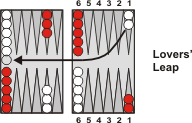
[Sometimes spelled "lovers' leap".] An opening roll of 6-5 played from the opponent's one-point to the player's mid-point.
-
Luck Factor
-
Equity gained or lost through the rolls of the dice during the course of a game or match. The luck associated with a roll is the difference in equity of the position before the roll and the (properly played) position after the roll. See posts by Gregg Cattanach and Adam Stocks.
-
Luck Reduction
-
Variance reduction (2).
|
|
|
M
|
-
Magriel's Safe-Bold Criteria
-
[Listed by Paul Magriel in his book Backgammon.] Six criteria for determining whether a situation requires a safe play or a bold play. They are: (a) opponent's home board strength; (b) presence of an anchor in opponent's home board; (c) your home board strength; (d) blots in opponent's home board; (e) number of checkers you have back; and (f) number of checkers opponent has back. Criteria (a) and (f) call for making a safe play; the others point towards making a bold play.
-
Main Division
-
Main flight.
-
Main Flight
-
In an elimination tournament, the group in which players start and compete in until they lose, and which offers the largest prize. Compare: Consolation Flight.
-
Major Split
-
Moving one of your two runners from the opponent's one-point to the opponent's four-point or five-point. Compare: Minor Split.
-
Make a Point
-
To place two checkers together on one point (1) so they form a block or an anchor. Your opponent may not land or touch down on that point as long as the two checkers remain there.
-
Make One's Board
-
To close all the points (1) in your home board.
-
Man
-
Checker.
-
Mandatory Beavers
-
An optional chouette rule which says: when only one player accepts box's initial double, that player must also beaver; otherwise, he must refuse the double along with everyone else. See post by Roland Scheicher. Compare: Mandatory Extras (1).
-
Mandatory Double
-
A game in match play where the doubling cube has reached a high-enough level that it represents sufficient points (4) for the leader to win the match; the trailer has nothing to lose by doubling at this point. This includes any post-Crawford game, where the trailing player should double at his first opportunity.
-
Mandatory Extras
-
- An optional rule for chouette play which says when only one player on the team accepts the box's initial double that player is obliged to accept an extra 2-cube from any other team member that wishes to pay him one point (4). See posts by Daniel Murphy and Toni Wuersch.
- An optional rule for money play which says whenever a double is offered and accepted the doubler has the right to give his opponent an extra cube at the same level accompanied by a payment equal to one half of its value. The receiver of an extra now has two cubes which he may use together or separately for making future doubles. See post by Albert Steg.
-
Mandatory Take
-
In post-Crawford match play, if the leader is offered a double when the trailing player has an odd number of points (4) to go, the leader should almost always accept the double. For example, as leader against an opponent who is 5-away, taking and losing two points means the opponent still needs two games (or one gammon) to win the match.
-
Man in the Box
-
See: Box.
-
Manny Wong Proposition
-
The player on roll has two checkers on each of his lower three home board points, and three checkers on each of upper three home board points. The opponent has one checker on the bar, six checkers borne off, and the remainder on his one-point and two-point. Should the player double? Should his opponent accept the double?
-
Market (for a Double)
-
An opportunity to offer a double while it will be accepted by the opponent.
-
Market Gainer
-
[By analogy to market loser.] A sequence of two rolls (one for you and one for your opponent) which takes a game from a position in which your opponent would refuse a double to a position in which your opponent would accept a double.
-
Market Loser
-
A sequence of two rolls (one for you and one for your opponent) which takes a game from a position in which your opponent would accept a double to a position in which your opponent would refuse a double. Knowing the number and size of your market losers is an important consideration in whether or not to double.
-
Market Losing Sequence
-
Market loser.
-
Match
-
A series of games between two players which ends when one player acquires a predetermined number of points. Traditionally, matches are played to an odd number of points (3, 5, 7, etc.). See: Match Play.
-
Match Equity
-
- A player's probability of winning a match from a given score.
- The value of a position in the context of the current match score and cube level, usually given in terms of match winning chances.
-
Match Equity Table
-
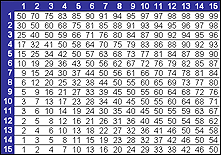
A chart showing the probability of winning a match from various scores. Example: The Woolsey-Heinrich match equity table. Match equity tables are laid out according to the number of points each player still needs to win the match. The first column and row represent the Crawford game.
-
Match Play
-
The method of competition used in tournaments and on many backgammon play sites. Two competitors play a series of games until one of them acquires a predetermined number of points (4). The doubling cube may be used except in the Crawford game. Unlike money play, you do not use automatic doubles, the Jacoby rule, or beavers in match play.
-
Match Winning Chances
-
A player's probability of winning a match. Compare: EMG Equity.
-
Material
-
Builders.
-
Mechanic
-
See: Dice Mechanic.
-
Mechanical Play
-
A move made with little thought because it seems to be obvious.
-
Mental Shift
-
A technique used in pip counting in which you imagine that some checkers have been moved to a higher or lower point where they can be counted more easily. You must either keep track of the number of pips moved or make a compensating shift elsewhere on the board.
-
MET
-
Match equity table.
-
Mexican Backgammon
-
A backgammon variant similar to Acey-Deucey (2) in which a roll of 1 and 2, called a Mexican, gives the player extra turns. See: How to Play Mexican Backgammon.
-
Meyer Dice Tube
-
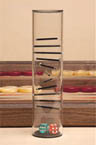
A 9-inch clear plastic tube with baffles across the middle and capped ends that contains a pair of dice and is used to randomize dice within. You place the tube on one end with the dice lying on the bottom. To roll the dice, you pick up the tube, quickly turn it 180 degrees, and set it back down, allowing the dice to fall through the baffles and land on the other side. Website: Meyer Dice Tube. See: Chuck Bower's article: "A Closer Look at the Meyer Dice Tube."
-
Middle Game
-
The main body of the game, which begins after the players have settled on their initial game plan. Compare: Opening Game and End Game.
-
Mid-Point
-
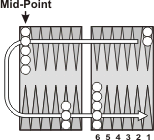
Your thirteen-point (the opponent's twelve-point), where you have five checkers at the beginning of the game.
-
Minor Split
-
Moving one of your two runners from the opponent's one-point to the opponent's two-point or three-point. Compare: Major Split.
-
Misere
-
A backgammon variant in which the object is to be the last player to bear off all of your checkers. See: How to Play Misere Backgammon.
-
Mixed Roll
-
Two thrown dice with different numbers on their upper faces. Compare: Doubles.
-
Mobility
-
The degree to which a position permits dice rolls to be played freely while maintaining the position's key features. A mobile position strikes a balance between the made points and spare checkers.
-
Modern Backgammon
-
- A term used in the late 1920's and early 1930's for the new rules of the time, including the use of the doubling cube and chouette play.
- A term used in the late 1990's and early 2000's for a style of play inspired by computer analysis.
-
Money Management
-
Choosing appropriate stakes to play for so that you do not exceed your bankroll. Money management has two goals: to ensure that your bankroll lasts the entire session and to make playing more fun by removing some of the stress involved in dealing with money. See post by Adam Stocks.
-
Money Play
-
The normal style of competition in backgammon in which games are played individually and the participants bet on the result. At the end of each game, the loser pays the winner the agreed initial stake multiplied by the value of the doubling cube and further multiplied by 2 for a gammon or 3 for a backgammon (2). Money play backgammon is normally played using the Jacoby rule and participants may also agree to play automatic doubles and beavers. Compare: Match Play.
-
Monte Carlo
-
Location of the annual World Championship of backgammon.
-
Motif
-
A Java applet that plays backgammon. Website: Motif Plays Backgammon.
-
Moultezim
-
A Turkish game in which players start at diagonally opposite corners and move around the board in the same direction. There is no hitting and one checker by itself controls a point (1). See: How to Play Moultezim.
-
Move
-
The advancement of a checker according to the number showing on one of the rolled dice. There are three types of legal moves you may make: (a) to enter a checker from the bar (your only legal move when you have a checker on the bar); (b) to move a checker forward the given number of pips (2) to an open point, possibly hitting an opposing blot; or (c) to bear off a checker, when all of your checkers are in their home board.
-
Move Around the Corner
-
A move from the opponent's outer board to the player's outer board.
-
Move Down
-
Move around the corner.
-
Move In
-
- A move from the bar to the opponent's home board.
- A move from your outer board to your home board.
-
Move Off
-
Bear off.
-
Move Out
-
A move from the opponent's home board to the opponent's outer board.
-
Move Up
-
A move forward within the opponent's home board.
-
Mutual Holding Game
-
A game in which both players hold advanced anchors on the opponent's side of the board in an attempt to hinder the opponent as he tries to bring his checkers home.
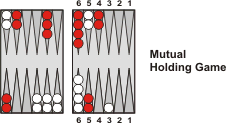
-
MWC
-
Match winning chances.
|
|
|
N
|
-
Nack Blitz
-
A tournament of 1-point Nackgammon matches.
-
Nackgammon
-
[Named after Nack Ballard, who popularized the game.] A backgammon variant played using the same rules as regular backgammon except for the starting position. Players start with 2 checkers on each of the opponent's one-point and two-point, 4 checkers on the mid-point, 3 checkers on the eight-point, and 4 checkers on the six-point. With fewer checkers up front for attacking, and more checkers back for anchoring and maneuvering, games tend to be longer and more positional. See: How to Play Nackgammon.
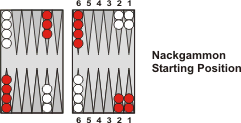
-
Nactation
-
[An amalgamation of "Nack" (for Nack Ballard) and "action notation."] A convenient notation for describing backgammon positions in the first several moves of the game. See: the Nactation Tutorial for a complete description.
-
Narde
-
[Also spelled "Nardi" and "Nardy".] A Russian game similar to Moultezim. See: How to Play Narde.
-
Neil's Numbers
-
[Devised by backgammon expert Neil Kazaross.] A mnemonic device for estimating match equity (1) based on the current match score. The leader's percent probability of winning the match is 50, plus his point (4) lead in the match multiplied by the appropriate Neil's number. See post by Kit Woolsey. Compare: Janowski's Formula and Turner's Formula.

-
Neural Network (Neural Net)
-
The architecture used in many of the strongest backgammon programs such as Jellyfish, Snowie, and GNU Backgammon. A neural network consists of many simple processors connected by unidirectional paths carrying numeric data. The network is "trained" by adjusting the weights of the connections until desired outputs are achieved for given inputs. See post by
Gary Wong.
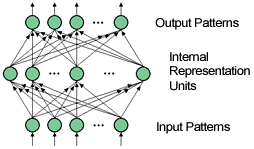
-
Next
-
[From the online match between Kit Woolsey and Readers at GammonU. When the Readers' play is obvious, they are greeted with a link that says "Next" and the game proceeds without a vote.] A move that is clearly better than the alternatives or obvious enough that it requires no explanation.
-
NN
-
Neural network.
-
No-Brainer
-
- Pure race.
- An easy decision.
-
No Dice
-
Cocked dice.
-
Noncommitted Position
-
A position with a flexible game plan; a game where there is more than one reasonable strategy for winning, such as racing, priming, or blitzing (1).
-
Nonprogressive Consolation
-
A consolation tournament for losers of the first round of the main tournament. Losers in later rounds of the main event do not get to enter the consolation event. Compare: Progressive Consolation.
-
Norges Backgammonforbund (NBGF)
-
Norwegian Backgammon Federation. Website: www.norgesbackgammonforbund.no.
-
Normal Game
-
Single game.
-
Normalized Match Score
-
A match score expressed in terms of the number of points (4) needed to win the match rather than the number of points won so far. For example, a score of 5-1 in a match to 7 would be "2-away/6-away". Normalized scores are used in match equity tables.
-
Notation
-
The method of representing the moves of a game. See post by Dean Gay.
-
Novice Division
-
The tournament division for the weakest players, particularly those who do not desire the stronger competition and higher entrance fees of the other divisions. Compare: Intermediate Division and Open Division.
-
Novice Level
-
A player who is new to backgammon. Compare: Intermediate and Advanced level.
-
N-Point Board
-
A home board with n made points.
-
N-Roll Position
-
A position in which you will bear off all of your checkers in n rolls or less. For example, having ten checkers left on your ace-point is a "5-roll position."
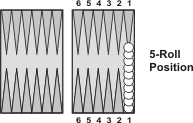
-
Nullo Play
-
A play which cannot be profitable for any possible sequence of future rolls.
|
|
|
O
|
-
Odds
-
The ratio of the probability of an event happening to that of its not happening, or vice versa. Usually the higher number is given first. For example, the odds of rolling double 6's are "35 to 1 against".
-
Off (the Board)
-
Said of checkers which have been borne off.
-
One-Checker Model
-
A model for estimating winning chances in a pure race based on the players' pip counts. In this model, all of a player's pips are represented by just one checker on a infinitely-long backgammon board. The one-checker model overestimates winning chances in positions where one side has more wastage than the other. See post by: Hugh Sconyers.
-
One-Point
-
The deepest point (1) in a player's home board, the point farthest from the bar and closest to being borne off; also called the ace-point.
-
One-Point Match
-
A backgammon variant where the goal is to be the first player to bear off all of your checkers. There is no doubling cube and no bonus for gammons or backgammons (2). Since you never lose more than one point (4), back games are more of an option in this variant than in regular backgammon. See posts by Lou Poppler and Bernhard Kaiser.
-
One-Sided Bearoff Database
-
A bearoff database where the arrangement of checkers on only one player's side is considered. The values in the database are calculated assuming the goal at each turn is to minimize the average number of rolls required to bear off. Compare: Two-Sided Bearoff Database.
-
Online Backgammon
-
This refers to playing backgammon over the Internet. Online backgammon allows players all over the world to compete against one another. You can play for rating points or for real money. See: Backgammon Server.
-
On Roll
-
The player whose turn it is. You are on roll as soon as your opponent picks up his dice to end his turn, and before you throw the dice to begin your own turn. For example, the only time you may double is when you are on roll.
-
On the Bar
-
Where a checker is placed after it is hit. When you have a checker on the bar, you may not move any of your other checkers until that checker has been entered back onto the board.
-
On Tilt
-
Steaming.
-
Open Division
-
The main division of a tournament; the division that any player may enter. Also called the championship division, it generally has the highest entry fee, the largest prizes, and attracts the strongest players. Compare: Novice Division and Intermediate Division.
-
Opening Game
-
The first phase of a backgammon game where the players have yet to establish their initial game plans. Compare: Middle Game and End Game.
-
Opening Roll
-
The first roll of the game in which both players simultaneously roll one die. This roll determines both the player to go first and the numbers that player must play.
-
Open Point
-
A position on the board not occupied by two or more of the opponent's checkers.
-
Open Tournament
-
A tournament open to any player regardless of strength or experience. See: Open Division.
-
Optional Reroll Rule
-
California rule.
-
OTB
-
Over the board.
-
Otter
-
[Another furry rodent, by analogy to beaver and raccoon.] An immediate redouble (while retaining ownership of the cube) by the player who just accepted a raccoon.
-
Outer Board
-
The side of the board away from where the players bear off their checkers. Each player's outer board comprises that player's points seven through twelve. Compare: Home Board.
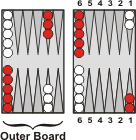
-
Outer Table
-
Outer board.
-
Outfield
-
The outer board, particularly points nine, ten, and eleven.
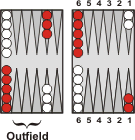
-
Outside Prime
-
A contiguous sequence of blocked points in which the majority of those points are in the outer board.
-
Overage
-
Points (4) won in excess of those needed to win a match. For example, if you win a game worth 4 points in a match in which you are 2 points away from winning, the surplus 2 points are overage.
-
Overplay
-
Make an unnecessarily big play.
-
Over the Board
-
Games played face-to-face, as opposed to on the Internet or by correspondence.
-
Own a Point
-
To have two or more checkers on a point (1) so that the opponent is blocked from landing or touching down there.
-
Owner of the Cube
-
The player who last accepted a double in the game. He places the cube on his side of the board to indicate that only he may make the next double. See: Cube Ownership.
-
Own the Cube
-
The player who last accepted a double is said to own the doubling cube. He places the cube on his side of the board. Only the owner of the cube may offer the next double in the same game. Compare: Centered Cube.
|
|
|
P
|
-
Parlay
-
A succession of events, each of which depends on the preceding event. The probability of the entire parlay is equal to the product of the probabilities of the individual events.
-
Partial Prime
-
A prime of fewer than six consecutive points (2). Compare: Full Prime.
-
Partner for the Box
-
Chouettes with a large number of players often permit the box to take a partner. The partnership is offered in rotation, starting with the captain and moving on down the line. If no one offers to be the box's partner, a partner may be chosen by lot from among the team members other than the captain.
-
Pass
-
Refuse a double.
-
Pay Later
-
To play safe in the current position but risk greater danger later in the game. Compare: Pay Now. See: Pay-Now-or-Pay-Later Decision.
-
Pay Now
-
To take an immediate risk (such as leaving a shot) to avoid the prospect of a more serious risk later in the game. Compare: Pay Later. See: Pay-Now-or-Pay-Later Decision.
-
Pay-Now-Or-Pay-Later Decision
-
[From a 1980's television commercial for FRAM oil filters which showed a ruined car engine and a mechanic who quipped: "You can pay me now, or you can pay me later."] The problem of whether to take a modest but definite risk on the current turn or wait and perhaps take a more serious risk in the future.
-
Perfecta
-
The best possible roll; a joker.
-
Pick and Pass
-
To hit an opposing blot and continue the same checker to safety on the same play.
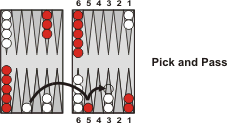
-
Pick Up
-
Hit a blot.
-
Piece
-
Checker.
-
Pigeon
-
The victim of a hustler.
-
Pip
-
- One of the spots on a die that indicate numeric value.
- A unit of distance on a backgammon board corresponding to the difference in point (1) numbers. For example, the 13-point and the seven-point are six pips apart.
-
Pip Count
-
The total number of points (or pips (2)) that a player must move his checkers to bring them home and bear them off. For example, at the start of a game each player has a pip count of 167: 48 pips for 2 checkers on the 24-point, plus 65 pips for 5 checkers on the 13-point, plus 24 pips for 3 checkers on the eight-point, plus 30 pips for 5 checkers on the six-point.
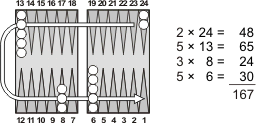
-
Plakoto
-
A Greek game in which players pin blots rather than hit them. See: How to Play Plakoto.
-
Play
-
The collection of moves a player makes in satisfying the requirements of a roll.
-
Player's Privilege
-
A fictitious rule invoked by James Bond in the movie Octopussy. Bond is playing backgammon with the villain, Kamal Khan. Khan is winning by using loaded dice that roll 6-6 when he switches them into the game. On the last roll Bond needs a 6-6 to win, so he calls out "player's privilege," which is apparently a rule allowing one player to exchange his dice for his opponent's. The loaded dice are still in Khan's cup, but he can't complain without revealing himself, so Bond takes the cup, rolls 6-6, and wins.
-
Play Safe
-
To avoid leaving blots which might be hit. See: Safe Play.
-
Play Site
-
Backgammon server.
-
Ply
-
One turn by one player, a measure of how far a player (or computer program) looks ahead when selecting a play or evaluating a position. See post by JP White. Note: There is no agreement in the backgammon community as to whether plies are counted starting at 0 (as GNU Backgammon does it) or starting at 1 (as Snowie does it). See this thread and this thread concerning the controversy.
-
POH
-
Point on head.
-
Point
-
- One of the twenty-four narrow triangles, twelve on each side, of a backgammon board, where the players' checkers sit. The points are numbered for each player 1 to 12 across the near side of the board and 13 to 24 in the other direction across the far side of the board. Either player's one-point is the other player's 24-point.
- Two or more checkers on the same triangle; a made point.
- To hit a blot and make the point in the same turn with the same roll; to point on a blot.
- A unit of scoring. Each game is worth 1, 2, or 3 points (for a single game, a gammon, or a backgammon (2)) multiplied by the value of the doubling cube. In money play, you play for a certain value per point. In match play, each match is played to a predetermined number of total points.
-
Point Game
-
An old method of scoring in backgammon (1) that is no longer used. The winner of the game gets 1 point for each checker in the loser's home board, 2 points for each checker in the loser's outer board, 3 points for each checker in the winner's outer table, and 4 points for each checker on the bar or in the winner's home table. See: 1931 Rules of Backgammon.
-
Point on a Blot
-
To hit an opposing blot with two of your checkers at the same time, thereby also making the point. Pointing on a blot in your home board is usually a very strong play.
-
Point on Head
-
Point on a blot.
-
Points per Game
-
A measure of playing performance equal to the total number of points (4) won (or lost) divided by the number of games played.
-
Poof
-
A backgammon variant in which you always play the lower number of a roll first. See: How to Play Poof.
-
Portes
-
A Greek game similar to Western backgammon (1). See: How to Play Portes.
-
Position
-
The arrangement of checkers on a backgammon board.
-
Positional Play
-
- A play that emphasizes fighting for and keeping key points over running or blitzing (1); a structural play.
- A checker-play decision where strategy considerations dominate. See post by Adam Stocks. Compare: Technical Play.
-
Position Card
-
A card with a preprinted diagram of a backgammon board designed for recording a position.
-
Possession of the Doubling Cube
-
The player who last accepted a double is said to own the cube. Only that player may make the next double of the game. Prior to the first double, neither player owns the cube (see centered cube) and either player may double.
-
Post-Crawford
-
After the Crawford game.
-
Post Mortem
-
Analysis of a game or match after it has been completed.
-
Pottle's Law
-
[Named for backgammon player Sam Pottle.] "Always run the last checker." If you have only one checker back, the best move is usually to run that checker. See post by Stick Rice.
-
PPG
-
Points per Game.
-
PRAT
-
Acronym for "Position, Race, And Threats," a guideline for making cube decisions. According to the guideline, a player should double if he has an advantage in two of the three areas. And his opponent should pass if the player who doubled has an advantage in all three areas. See post by Alan Webb.
-
Precision Dice
-
Dice which have been carefully cut so their shape and balance are more accurate than regular dice and have pips (1) that are flat and not dimpled. See posts by Patti Beadles and Larry Strommen.
-
Preclear
-
To evacuate a high point (1) in your home board before all of your checkers are home in preparation for bearing off. You sometimes do this when the opponent holds an anchor deep in your home board and you are worried about clearing a high point safely during the bear off. By preclearing, you take advantage of opportune rolls at the time you get them.
-
Pre-Crawford
-
Before the Crawford game.
-
Premature Burial
-
Taking one or more checkers deep into your home board early in the game out of undue concern for short-term safety.
-
Premature Roll
-
A dice roll made by a player before the opponent has ended his turn by picking up the dice. Under U.S. rules, the premature roll is invalid and must be rethrown. Under BIBA rules, the premature roll stands but the player who did not pick up the dice may change his play in light of the new information.
-
Pressure
-
To advance a runner so it directly bears on an opponent's blot, forcing the opponent to cover the blot, move it, or risk it being hit.
-
Prime
-
- Six consecutive made points. An opposing checker trapped behind a prime cannot escape until the prime is broken.
- Several consecutive made points, such as a 4-prime or 5-prime.
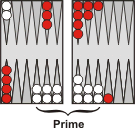
-
Primed
-
Trapped behind a prime.
-
Prime Fighter
-
A player who accepts a double when he has one or more checkers trapped behind an opponent's prime.
-
Prime-vs-Prime
-
A game in which both players have primes with opposing checkers trapped behind them. The winner of these games is often the player with better timing.
-
Priming Game
-
A type of game in which the primary strategy is to trap one or more opponent's checkers behind your prime.
-
Progressive Consolation
-
A consolation tournament for losers in the first several rounds of the main tournament. Progressive means that losers in later rounds of the main event get one or more byes to later rounds of the consolation event. Compare: Nonprogressive Consolation.
-
Prop
-
Proposition.
-
Proposition
-
A prearranged position played several times, usually for money, as a means of settling a dispute over which checker play (1) or cube action is best. See: Take/Drop Proposition.
-
Proxy
-
See Cube Proxy.
-
Puff
-
- The German name for backgammon (1).
- A German backgammon variant in which players enter in the same quadrant and move around the board in the same direction.
-
Pure Play
-
["Pure" because it focuses on one game plan.] Playing with the goal of making a prime. Pure play includes bringing builders into play quickly, slotting to make key points, keeping your checkers in front of the opponent's checkers, and recirculating checkers as necessary. See post by Daniel Murphy and this thread.
-
Pure Race
-
A game in which the opposing forces have disengaged so there is no opportunity for further blocking or hitting by either side. In a pure race, your goal is simply to get your checkers home as quickly as possible and bear them off. Compare: Contact Position.
|
|
|
Q
|
-
Quacks
-
Double ducks.
-
Quadrant
-
One quarter of the playing area on a backgammon board. The first quadrant comprises a player's points 1 to 6, the second quadrant points 7 to 12, the third quadrant points 13 to 18, and the fourth quadrant points 19 to 24.
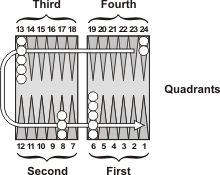
-
Quads
-
The roll of 4-4 on the dice (double 4's).
-
Quarter Entry
-
A quarter entry is a single elimination tournament for four players, which is held before the beginning of a greater tournament. Each of the four contestants pays an entry fee of (usually slightly more than) a quarter of the entry fee of the main event. The winner of this four person tournament is entitled to play in the main event.
-
Quasi-Random Dice
-
A technique used to reduce the element of luck in a rollout by ensuring the numbers rolled in the first few rolls of each trial are as evenly distributed as possible. For example, if you roll out a position 36 times, quasi-random dice will ensure that each trial begins with a different roll.
-
Quatre-Point
-
Traditional name for the four-point.
-
Quiet Play
-
An unassuming play that does not hit, or slot, or pose an immediate threat; it just maintains the status quo.
-
Quiz Factor
-
A feature of a problem that makes it interesting enough to appear on a quiz. The mere appearance on a quiz suggests that the "obvious" play may not be the correct play.
|
|
|
R
|
-
Raccoon
-
An immediate redouble by the player who just accepted a beaver.
-
Race
-
- Pure race.
- The relative standing of the players' pip counts. The player with the lower pip count is said to be ahead in the race.
-
Race Equity
-
Winning chances that accrue from variations where there is no further hitting.
-
Rail
-
Bar.
-
Railroad Tracks
-
To pile all your checkers on a few points (1); also called candlesticks.
-
Rake
-
A fee charged by a backgammon play site for hosting money games. It is usually a percentage of the winnings of each game.
-
Random Error (in a Rollout)
-
Variation in the result of a rollout due to chance. It results when the rolls for one side are luckier overall than the rolls for the other side. You can reduce the random error in a rollout by increasing the number of trials. Compare: Systematic Error.
-
Random Seed
-
A numeric value that uniquely determines the sequence of dice rolls produced by a random number generator.
-
Rated Match
-
A match that counts towards your rating.
-
Rating
-
A number associated with each player based on that player's record of performance against other rated players. When you win a match, points are added to your rating; when you lose, points are deducted from your rating. The size of the adjustment depends on the strength of your opponent—the higher the rating of your opponent, the more points you receive. Over time, your rating will tend to be higher than players weaker than yourself, and lower than players stronger than yourself. See: FIBS rating formula.
-
Rating Points
-
Points assigned by a ratings system to players based on their performance against other rated players.
-
Ratings Inflation
-
A phenomenon that results when players exit a ratings pool at a lower rating than when they entered. The lost ratings remain with the players still in the pool, giving a higher average rating overall.
-
Ratings Pool
-
The people who participate in a ratings system.
-
Ratings System
-
A method of assigning ratings to players based on their performance in such a way that players with greater ability will, over time, tend to have higher ratings.
-
Raw Take Point
-
The minimum game winning chances you need to accept a double if you assume no gammons and no further cube action. The raw take point can be derived from a match equity table and depends only on the score of the match, not on the position. See post by Timothy Chow. Compare: Take point.
-
Recirculate
-
To intentionally allow a blot to be hit for the purpose of gaining time to preserve other valuable points (2).
-
Recube
-
Redouble.
-
Recube Vigorish (Vig)
-
The value of cube ownership to the player being offered a double; the additional equity that comes from being the only player who may redouble.
-
Redouble
-
A double other than the first double of a game. Only the player who last accepted a double may redouble. Compare: Initial Double.
-
Reenter
-
Enter a checker from the bar after it has been hit.
-
Reference Position
-
A position of known value that serves as a standard by which other similar positions may be measured or judged. See: Cube Reference Position.
-
Refuse a Double
-
To resign the game at the current stakes after the opponent offers a double rather than continue play at twice the stakes. Compare: Accept a Double.
-
Resign
-
To accept defeat. Resignation is a form of settlement; when you resign you must specify whether you are resigning a single game, a gammon, or a backgammon (2), and the opponent must agree. Resigning is not allowed in tournament play before contact is broken.
-
Return Shot
-
A chance to hit back after being hit yourself.
-
Rim
-
Bar.
-
Robustness
-
Mobility.
-
Roll
-
- [Verb.] To throw a pair of dice.
- [Noun.] Two thrown dice, each showing a number from 1 to 6.
-
Roll a Prime
-
To make a new point at the leading edge of a prime using checkers from the rear of the prime. Usually the easiest way to roll a prime forward is to slot the point immediately in front of the prime.
-
Roll Out
-
- To analyze a position by playing it out over and over again.
- To estimate the equity of a position by means of computer simulation; see rollout.
-
Rollout
-
An estimate of the equity of a position obtained through computer simulation. A rollout consists of numerous trials, the results of which are averaged together. See post by Gregg Cattanach. See also: Truncated Rollout, Cubeless Rollout, Cubeful Rollout, Random Error, and Systematic Error.
-
Roll-Over
-
A backgammon variant in which players have a once-per-game option of rerolling their own dice or asking for a reroll of the opponent's dice. See: How to Play Roll-Over.
-
Roof
-
Bar.
-
Root Number
-
[Because you "root" for your opponent to roll one.] A dice roll that forces a position to collapse.
-
Round
-
A period in a tournament during which each contestant (except those who received a bye) plays another contestant. For example, each round of an elimination tournament eliminates half the players.
-
Round Robin Format
-
A tournament format in which every contestant plays every other contestant in turn. The number of rounds required is one less than the number of contestants. Compare: Elimination Format.

-
Run
-
To escape a runner from the opponent's home board and it advance toward home as quickly as possible.
-
Runner
-
- One of the two checkers that began the game on the opponent's one-point.
- Any checker on the bar or in the opponent's home board.
-
Running Game
-
- The strategy employed by a player who is ahead in the race and tries to bring his checkers home and bear them off with as little interaction with the opponent as possible.
- The stage of a backgammon game which begins when contact with the opponent is broken; a pure race.
-
Russian Backgammon
-
A backgammon variant in which all checkers start off the board, and both players enter in the same quadrant, move around the board (1) in the same direction, and bear off from the same quadrant. See: How to Play Russian Backgammon.
|
|
|
S
|
-
Safe
-
Free from danger of being hit.
-
Safe-Bold Criteria
-
See: Magriel's Safe-Bold Criteria.
-
Safe Play
-
A play that leaves no blots, or a play that leaves blots only in positions where the opponent is unlikely to hit. Compare: Bold Play.
-
Safety a Checker
-
Move a checker out of danger of being hit.
-
Safety Up
-
Cover a blot or move it out of range of being hit.
-
Sandbag
-
- To conceal or misrepresent your true ability.
- To enter a tournament division below your skill level.
-
Save a Number
-
To leave a position in which a particular number will play comfortably next turn so you will not be forced you to destroy your position if you roll that number. Typically, you save a number to avoid having to leave a shot or break a valuable point. Compare: Kill a Number.
-
Save Backgammon
-
To escape all of your checkers from the opponent's home board before he is able to bear off all of his own checkers, and thereby avoid losing a backgammon (2).
-
Save Gammon
-
To bear off one of your own checkers before the opponent has borne off all of his, and thereby avoid losing a gammon.
-
Secure a Point
-
Cover a blot.
-
Seed
-
See: Random Seed.
-
Seeded Player
-
A competitor in a tournament whose position in the draw is predetermined to ensure that he will not meet other seeded players in the early rounds of an elimination event. See this thread.
-
Semiactive Builder
-
A checker which may or may not be available to make another point, depending on the roll.
-
Semifinalist
-
One of the four players competing in the semifinals of an elimination tournament.
-
Semifinals
-
The second-last round of an elimination tournament; the one that determines the two players who advance to the finals.
-
Settlement
-
A decision to end a game early with the payment of points by one player to the other based on the agreed fair value of the position (see Equity). Settlements are generally not allowed in tournament play.
-
Settlement Limit
-
A method of reducing the variance of a cubeful rollout. Any trial in which the equity of a player exceeds a given value (the settlement limit) is terminated at that point and scored as double/drop. See posts by Michael J. Zehr and Kit Woolsey.
-
Setup
-
See: Starting Position.
-
Shake
-
To mix the dice using a dice cup prior to rolling.
-
Shark
-
A good player who seeks out weaker players and persuades them to play for high stakes. (Sharks eat fish.)
-
Shesh Besh
-
A Turkish game similar to Western backgammon (1). See: How to Play Shesh Besh.
-
Shift Gears
-
Change game plan.
-
Shift Points
-
To give up one point in order to make an adjacent point.
-
Shot
-
- An opportunity to hit an opposing blot. A direct shot is an opportunity to hit using a single number. An indirect shot is an opportunity to hit using both numbers of the dice played with the same checker.
- A particular roll of the dice which could hit an enemy blot. When counting shots, you count each doubles roll once and each mixed roll twice to get a total out of 36.
-
Shut Out
-
Close out.
-
Side Pool
-
A separate tournament prize fund made up of additional optional entry fees which goes to the highest finishing player(s) of those who entered the side pool. The side pool allows a tournament to keep the regular entry fee low while providing players willing to pay a higher entry fee a chance to win more. See post by Daniel Murphy.
-
Side Prime
-
Prime (1).
-
Silver Point
-
[By analogy to the golden point.] A term sometimes used for the opponent's four-point, the second best point on which to anchor.
-
Simple Direct Shot
-
A blot within range of being hit with a single number but for which there are no ways to hit using a combination of numbers on both dice.
-
Simulation
-
Rollout.
-
Single Elimination
-
A tournament format in which a competitor continues playing until he loses. See: Elimination Format. Compare: Double Elimination.
-
Single Game
-
A completed game which is not a gammon or a backgammon (2); a game in which the losing player has borne off at least one checker. The winner of a single game receives the value of the doubling cube only and no bonus.
-
Single Shot
-
One blot which can be directly hit one way. Compare: Double Shot.
-
Six-Point
-
The sixth point (1) in a player's home board; the point adjacent to the bar.
-
Slot
-
To place a single checker on a point (1) you wish to make with the intention of covering the blot on your next turn.
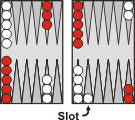
-
Slot and Split
-
To slot a checker in your own home board while your runners are split.
-
Small Play
-
A safe play when a bolder, more aggressive play is available. Compare: Big Play.
-
Snake
-
A backgammon variant in which one player starts with nine checkers on the bar and his remaining six checkers in the opponent's home board. See: How to Play Snake.
-
Snake Eyes
-
The roll of 1-1 on the dice (double 1's).
-
Snowie
-
The second commercial neural-net backgammon program (1998) after Jellyfish. Website: Snowie Backgammon.
-
Solid Prime
-
A prime with no gaps; a full prime. Compare: Broken Prime.
-
Spare Checker
-
An extra checker that can be used for hitting or making a point without leaving behind a blot.
-
Speed Board
-
A bearoff position in which you expect to take at least two checkers off every roll, typically when all of your checkers are crowded onto the three lowest points of your home board.
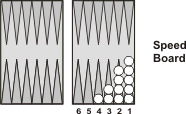
-
Split
-
To separate two checkers which are together on a point (1) (usually the opponent's one-point) and leave them as blots. See: Major Split and Minor Split.
-
Splot
-
[Coined by Chuck Bower.] A play that splits (at the back) and slots (at the front) at the same time. Paul Magriel recommended against splitting and slotting because it leaves you weak in two areas of the board, but there are exceptions.
-
Squeeze
-
To take advantage of the opponent's requirement to make a move. You leave him a position in which the only move he can make hurts his position. Often this means he is forced to break a valuable defensive point (2) earlier than he would like.
-
Stack
-
Four or more checkers piled on a point (1). See: Candlesticks.
-
Staine's Rule
-
An optional rule where rolls of doubles are played like any other roll; that is, each number is played once, not twice. See: Irish.
-
Stake
-
The amount wagered by the participants in a game of backgammon (1). The current stake is the initial stake multiplied by the value of the doubling cube.
-
Stakes Play
-
Money play.
-
Standard Deviation
-
A measure of a rollout's variance or random error. A rollout will be within one standard deviation of its convergence value 66% of the time, within two standard deviations 95% of the time, and within three standard deviations 99.7% of the time. See also: Joint Standard Deviation.
-
Start a Point
-
To move a checker to a point (1) you wish to make with the hope of covering that checker on your next turn.
-
Starting Position
-
The arrangement of checkers at the start of a game. Each player has 2 checkers on the opponent's one-point, 5 checkers on the mid-point, 3 checkers on the eight-point, and 5 checkers on the six-point. See: the Rules of Backgammon.
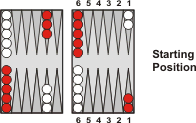
-
Stay Back
-
Remain in the opponent's home board.
-
Stay Off
-
Fail to enter from the bar.
-
Stay Out
-
Fail to enter from the bar.
-
Steam
-
[What happens when a player reaches the "boiling point."] To play wildly, out of annoyance or impatience at one's bad luck. To lose one's emotional stability in a gambling context; in particular, to take bigger and bigger risks in an effort to recoup earlier losses.
-
Steamer
-
One who steams.
-
Stone
-
Checker.
-
Stop Pot
-
A progressive jackpot that allows players to enter at any level and cash out when they want. When you are ready to play, you sign up for a stop pot at some level. As soon as a second player is ready to play at that level, you play your match. Stop pots minimize the impact on the rest of the tournament because matches can be played whenever two players are available and the winner can cash out or continue playing depending on his obligations elsewhere.
-
Straggler
-
The last lone checker heading for home.
-
Straight Race
-
Pure race.
-
Strategy
-
The overall, long range plans for a game. The reasoning behind a play. See: Game Plan. Compare: Tactics.
-
Stretched
-
A position barren of spare checkers or builders and thus prone to awkward numbers; too many points.
-
Strip a Point
-
To remove all but two checkers from a point (1).
-
Stripped
-
A position barren of spare checkers or builders and thus prone to awkward numbers.
-
Stroke
-
To deliberately make an illegal play or otherwise take an unfair advantage.
-
Strong Board
-
A home board with several made points.
-
Structural Play
-
A play which makes a strong point.
-
Suicide Play
-
To purposely leave a blot to be hit so it can be recirculated. The idea is to improve your timing or shore up your defense in the opponent's home board. Also known as a Hara-Kiri play.
-
Svenska Backgammonförbundet (SBGF)
-
Swedish Backgammon Federation. Website: www.sbgf.se.
-
Swedish Tables
-
A backgammon variant in which players can win by arranging their checkers into specific patterns within their home board. See: How to Play Swedish Tables.
-
Swing
-
- The difference in score between winning a game and losing it.
- The difference in your equity before a roll and after it, or the difference between rolling poorly and rolling well.
-
Swiss-Cheese Formation
-
A position with many gaps and few adjacent made points.
-
Swiss Format
-
A method of pairing players in a tournament. Under the Swiss system, players are not eliminated, no player meets the same opponent twice, and successive rounds match players with scores as similar to each other as possible. See post by Osman Guner.
-
Switch Points
-
To give up one point (2) to make another, usually in your home board.
-
Sydney
-
The roll of 1-6 to escape a prime, usually from the bar and often hitting a blot.
-
Sympathy Flight
-
Consolation flight.
-
Systematic Error
-
Bias introduced in a rollout because of errors in checker play (2) or cube play (2).
|
|
|
T
|
-
Table
-
- An entire backgammon board.
- One of the four quadrants of a backgammon board; for example, your inner table or outer table.
-
Tables
-
- The English name for the Roman game Tabula.
- A generic term for any game played on a backgammon board.
-
Table Stakes
-
A system of betting where the players' stake in a game is limited to an agreed fixed amount. The idea is to protect the players from losing more money than they have at hand. It also evens the playing field when one player has more money at his disposal than the other.
-
Tabula
-
A Roman game similar to backgammon in which players use three dice instead of two, and move around the board in the same direction. The game was also popular in England where it was known as Tables. See: How to Play Tabula.
-
Tactics
-
Short-term, calculable aspects of the game, as opposed to strategic considerations. Tactics in backgammon include: hitting blots, making points, clearing points, and avoiding unnecessary risks.
-
Tailgate
-
To start to throw your dice before the opponent has picked up his own dice to finish his turn; to roll prematurely.
-
Take
-
Accept a double.
-
Take/Drop Proposition
-
A way to settle a difference of opinion about whether a position is a take or a drop by playing a series of games starting with the position in question. The player who believes the position is a take plays the taking side owning a 2-cube and gets one point added to his score for each game played.
-
Take Off
-
Bear off.
-
Take Point
-
The minimum game winning chances at which it is correct for a player to accept a double; the point at which a player is equally well off accepting a double or refusing a double; a player's drop point. Compare: Raw take point.
-
Take Up
-
Hit a blot.
-
Takhteh
-
A Persian game similar to Western backgammon (1). See: How to Play Takhteh.
-
Tapa
-
A game popular in Bulgaria in which players pin opposing blots rather than hit them. See: How to Play Tapa.
-
Tavla
-
A Turkish game similar to Western backgammon. See: How to Play Tavla.
-
Tavli
-
The Greek name for games played on a backgammon board. These typically include Portes, Plakoto, and Fevga. See: How to Play Tavli.
-
TD
-
Tournament director.
-
TD-Gammon
-
The first strong neural-net backgammon program (1991), written by Gerald Tesauro. See: Temporal Difference Learning and TD-Gammon and Learning from the Machine.
-
Team
-
In a chouette, the players lead by the captain who play against the box; the captain and his crew.
-
Technical Play
-
A checker-play decision which primarily depends on tactical considerations. See post by Adam Stocks. Compare: Positional Play.
-
Tell
-
An inadvertent clue as to whether you will be taking or dropping if offered a double. See post by: Tad Bright.
-
Temperature Map
-
A plot showing how a position's equity is distributed among each of the 6 x 6 upcoming rolls. It provides a way to visualize aspects of a position such as volatility and duplication. See: Equity Temperature Map: Introduction.
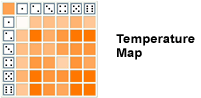
-
Tempo
-
A unit of time in positional development equal to half a roll.
-
Tempo Move
-
A hit designed to forestall the opponent by depriving him of half a roll when the opponent threatens to hit a blot or make an important point, or needs to consolidate a disorganized position.
-
Tempt
-
To intentionally place a blot in a position where it can be hit with the idea of enticing the opponent to give up a strategic point (2).
-
The T.P.
-
A player's two-point.
-
Thorp Count
-
A formula devised by Edward O. Thorp for making doubling decisions in pure race games. It is a modification of the basic pip count designed to take into account elements of checker distribution. Each player's Thorp count is his pip count, plus 2 for each of his checkers still on the board, minus 1 for each of his occupied home board points, plus 1 for each checker on his one-point. Then the player on roll increases his count by 10 percent if it is more than 30. Thorp advises: Double any time your count does not exceed the opponent's by more than 2; redouble any time your count does not exceed opponent's by more than 1; accept the double if your count does not exceed doubler's by more than 2. See post by Simon Woodhead. For a comparison with other methods, see the article, "Cube Handling In Noncontact Positions".
-
Three-Point
-
The third point (1) in a player's home board, counting from the edge of the board toward the bar.
-
Throw
-
To shake a pair of dice in a dice cup and release them onto a backgammon board. If the dice are cocked, they must be rethrown.
-
Throw Off
-
Bear off.
-
Time
-
The average number of rolls or pips (2) that can be played without having to make a major concession, such as leaving a blot, breaking a key point, or burying a checker. See post by Marty Storer.
-
Time Delay
-
A feature of digital chess clocks which gives each player a specified number of seconds at the start of each turn before that player's clock begins running. Typical time delays in backgammon range from 8 to 15 seconds per move. The idea is that players are charged only for "thinking time" and not for the time required to roll the dice, wait for them to settle, read the numbers and move the checkers.
-
Timing
-
How long you expect to retain the desirable features of a position compared to your opponent. Good timing means your opponent will be forced to make a major concession, such as leaving a blot, breaking a key point, or burying a checker, before you. You can sometimes help preserve your timing by killing large numbers or recirculating checkers.
-
TMP
-
Too many points.
-
Too Good (to Double)
-
A position which you should not double, even though your opponent has a clear drop, because your equity is higher by playing on for a gammon.
-
Too Many Points
-
An inflexible position with many made points and few spare checkers. Seven is usually "too many."
-
Touch Down
-
To temporarily land on an intermediate open point after playing one of two numbers with the same checker.
-
Touch Move Rule
-
An rule rarely used today in Western backgammon, though it is common in the Middle East. The rule requires that once you touch a checker (other than to adjust it) you must move that checker, and once you remove your hand from a properly played checker, that checker must remain where it was played. See this thread and this thread.
-
Tournament
-
A formal competition among multiple entrants in which a winner is decided.
-
Tournament Director
-
The person who organizes and oversees a tournament.
-
Tourne-Case
-
A game popular in seventeenth-century France in which players have just three checkers each and play only on their own side of the board. See: How to Play Tourne-case.
-
Trailer
-
The player who is behind in a match or behind in the race (2). Compare: Leader.
-
Transposition
-
Reaching the same position by different means.
-
Trap Play
-
A deliberate attempt to squeeze the opponent off of his anchor so that the trapper can close out any blots thereby exposed and win a gammon.
-
Trey-Point
-
Traditional name for the three-point.
-
Trial (of a Rollout)
-
Playing a position out to the end of the game once (or to the point of truncation). A rollout consists of multiple trials, the results of which are averaged together to yield an estimate of the equity of the position.
-
Trice Count
-
Another name for the effective pip count, a concept developed by Walter Trice who wrote extensively about it.
-
Trice Triangle
-
[Named for Walter Trice.] The ideal position to aim for during bear-in, consisting of: 7 checkers on your six-point, 5 checkers on your five-point, and 3 checkers on your four-point. It has the lowest wastage of any position with all 15 checkers still on the board.
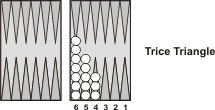
-
Trictrac
-
- A game popular in French high society prior to the Revolution. Players score points for making specific plays or moving their checkers into certain configurations. See: How to Play Trictrac.
- The French name for "backgammon."
-
Triple Game
-
Backgammon (2).
-
Trois-Point
-
Traditional name for the three-point.
-
Truncated Rollout
-
A rollout which is not played to the end of the game. Instead, the position is rolled out a given number of plies (the horizon of the rollout) and estimates of the equities of the resulting positions are averaged together. A truncated rollout has more systematic error than a full rollout but is faster because each trial is shorter, and a truncated rollout has less variance so fewer trials are required to converge on a result. See post by Gregg Cattanach.
-
Turn
-
The sequence of actions that each player takes in alternation. One turn consists of: (a) possibly offering a double; (b) rolling the dice; (c) playing the roll; and (d) picking up the dice.
-
Turner's Formula
-
A simple formula devised by Stephen Turner for estimating the match equity (1) at a given score. Expressed as a percent, the leader's match equity E = 50 + (24/T + 3) * D, where T is the number of points (4) the trailer still needs and D is the difference in scores. See post by Stephen Turner. Compare: Janowski's Formula and Neil's Numbers.
-
Turn the Corner
-
Move from the opponent's outer board to your own outer board.
-
Turn the Crank
-
To offer a double.
-
Turn the Cube
-
To offer a double.
-
Tutor Mode
-
A mode available in some backgammon-playing programs which allows the computer to evaluate your moves as you make them and alert you to any errors it thinks you made.
-
Twist the Cube
-
To offer a double.
-
Two-Point
-
The second point (1) in a player's home board, adjacent to the one-point; also called the deuce-point.
-
Two-Sided Bearoff Database
-
A bearoff database with the correct equity for each possible combination of two opposing bearoff positions. Four separate equities are recorded for each position: three cubeful equities (one for each state of the doubling cube), and one cubeless equity. A two-sided database is more accurate than a one-sided database, but requires considerably more room.
|
|
|
V
|
-
Variance (of a Rollout)
-
Level of random error in a rollout.
-
Variance Reduction
-
- Any technique for reducing the random error of a rollout. Examples are: quasi-random dice, duplicate dice, and luck reduction.
- Luck reduction, a variance reduction technique that involves adjusting each trial's result based on an estimate of the luck associated with the rolls of the trial. Because luck reduction is by far the most effective technique for variance reduction, the term variance reduction is often used specifically to refer to this method. See posts by Jim Williams and David Montgomery.
-
Variant
-
Any game other than backgammon (1) which can be played on a backgammon board. Most backgammon variants use rolls of the dice to determine how the players' checkers move, just as in backgammon. See: Backgammon Variants.
-
Vidos
-
The Greek name for the exact equivalent of Western backgammon. Greek backgammon, called portes, is slightly different than vidos in that it is played without a doubling cube and has no bonus for winning a backgammon (2).
-
Vig
-
Vigorish.
-
Vigorish
-
The small additional considerations that affect the total equity of a position, such as gammon vigorish and recube vigorish.
-
Volatility
-
A measure of how much a position's equity is likely to change in the next roll or two. See posts by Chuck Bower and Kit Woolsey.
-
Voluntary Double
-
A regular double, where one player offers to double the stakes of the game, as opposed an automatic double when identical numbers are thrown at the beginning of the game.
-
Volunteer a Shot
-
Purposely leave a blot within range of being hit now rather than be forced to leave it later when the danger may be greater.
|
|
|
W
|
-
Walk a Prime
-
Roll a prime.
-
Ward Count
-
A formula devised by Jeff Ward for making cube decisions in pure race games. It is a modification of the basic pip count designed to take into account elements of checker distribution. Each player's Ward count is his pip count, plus 2 for each checker more than 2 on the one-point, minus 1 for each extra home-board point compared to the opponent, plus 2 for each extra checker on the board compared to the opponent, plus 1/2 pip for each extra checker outside the home-board compared to the opponent. Then the player on roll increases his count by 10 percent. Ward advises: Double if your count does not exceed the opponent's by more than 2; redouble if your count does not exceed the opponent's by more than 1; accept the double if your count does not exceed doubler's by more than 2 in a short race (50 pips), 3 in a medium race (75 pips), or 4 in a long race (100 pips). See post by Marty Storer. For a comparison with other methods, see the article, "Cube Handling In Noncontact Positions".
-
Wash
-
- A blitzing (1) technique that involves switching points to hit an opposing blot.
- ["Wash" the slate clean.] A settlement for zero points.
-
Wastage
-
The expected loss in pips (2) from dice rolls not fully utilized during bearoff. Wastage is calculated as W = R x 49/6 − PC, where R is the expected (average) number rolls required to bear off, and PC is the pip count of the position. Wastage is the difference between the usual pip count and the effective pip count. See post by David Montgomery.
-
WBA
-
World Backgammon Association. Website: WBA.
-
WBF
-
Worldwide Backgammon Federation. Website: WBF.
-
Weaver Coup
-
A ploy which may be attempted when you are playing on for a gammon and the opponent gets a lucky roll. You offer to double even if your position is still too good, hoping the opponent will mistakenly accept. See this thread.
-
Whopper
-
A checker play (2) error or cube play (2) error which costs more than 0.1 points of EMG equity; a blunder. See post by Daniel Murphy.
-
Wipeout
-
Blitz (1).
-
Wisecarver Paradox:
-
A straight race position in which a given roll played correctly induces the opponent to correctly double while an alternate (inferior) play would prevent the opponent from correctly doubling. This can happen when the correct play produces a position of greater volatility. Wisecarever paradox positions are examples of a cube provocation plays.
-
Woolsey's Law for Doubling
-
A rule of thumb advocated by backgammon expert Kit Woolsey: "If you are not absolutely sure whether a position is a take or a pass, then it is always correct to double." See The Doubling Rule, by Kit Woolsey.
|
|
|
Z
|
-
Zone of Attack
-
[Or simply the "zone".] Points 1 through 11 on your side of the board. The success of a blitz depends on the number of checkers you have in the zone. Usually 10 is enough to make a blitz worth trying.
|
|
Return to:
Backgammon Galore
|